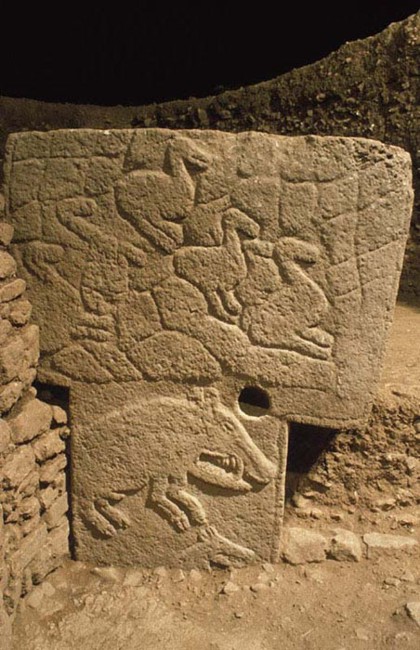
One of the stones from Göbekli Tepe with sitting birds
(most likely geese).
Dear Greg Stafford,
Thank you for writing to me.
1. Regarding your first question, according to what has been reported, it
seems that the carbon dating technique was used on some samples of charcoal and
also some organic material that was found on the stones. In this regard, a
writing of Wikipedia gives the following information at url http://en.wikipedia.org/wiki/G%C3%B6bekli_Tepe#Dating :
"The PPN A settlement has been dated to c. 9000 BC. There are remains of
smaller houses from the PPN B and a few epipalaeolithic finds as well.
There are a number of radiocarbon dates (presented with one standard deviation
errors and calibrations to BC):
Lab-Number Date BP Cal BC Context
Ua-19561 8430 ± 80 7560–7370 enclosure C
Ua-19562 8960 ± 85 8280–7970 enclosure B
Hd-20025 9452 ± 73 9110–8620 Layer III
Hd-20036 9559 ± 53 9130–8800 Layer III
The Hd samples are from charcoal in the lowest levels of the site and would date
the active phase of occupation. The Ua samples come from pedogenic carbonate
coatings on pillars and only indicate a time after the site was abandoned."
2. Your second question is
an important one, hence, we need to dwell on it extensively. Regarding the
seated birds and scorpions carved on the stones of Gobekli Tepe and also on
ivory findings at Abydos, my views are as follows:
Among the Göbekli Tepe stones, there is one stone that has five large and one
small sitting birds and also a picture of a boar. The sitting birds, in my
view, are "geese" and they seem to be sitting in a yard where the floor has been
finished with irregular shaped stones that make up a front or back yard similar
to an Anatolian village house (the picture reminds me of my village and the
house of my parents where we used to have many geese - it was part of the house
economy). If indeed they are geese as shown on the stone picture below, then it
is very important. First of all, the Turkish name for "goose" is KAZ (GAZ).
And I must point out that the English terms GOOSE and GEESE are nothing but
anagrammatized forms of the Turkish name KAZ (GAZ).
In the picture above, the upper left corner and also the upper right hand side
of the picture show a regularity indicating that the area that the birds are
sitting in is man made - where the area is covered with stones very much like
cobblestones are used to cover modern streets, and most likely, it is a front
yard of a house. In my village we used flat stones to cover a large area. Flat
stones were taken from a quarry which had naturally formed flat stones - that we
call "LEPIK" (LAPIK) in Turkish. The Latin word LAPIS meaning "stone" (where
letter S is actually a replacement for C which is also voiced as a K sound in
Latin) is from this Turkish word. In eastern Anatolian villages, this is done to
prevent having a muddy front yard. The picture above from Göbekli Tepe reminded
me of this culture in my own village. This picture seems to indicate that in
the ancient civilization of Göbekli Tepe, geese were one of the domesticated
birds. This could also be an indication that not only were domesticated geese of
different kinds (and other fowl such as chickens) a part of peoples' daily lives in
the Göbekli Tepe civilization, but also other domesticated animals such as
cattle, sheep, dogs and possibly horses were too. This would also tell us that
they were far beyond the so-called "hunter-gatherer" stage of human develoment.
It is also important to note, for example, that in the ancient Masarian
(so-called "Egyptian") culture, they, too, had domesticated geese, and, they had
a "Goose God", [E. A. Wallis
Budge, "An Egyptian
Hieroglyphic Dictionary, Volume II, p.
611a] , under the trancribed name of "SERU", [E.
A. Wallis Budge, p.
611a], while another entry,
transcribed as "SERA", is
described as "a kind of goose". The transcribed name "SERA"
must be Turkish word "SARI" meaning "yellow", thus, the goose they are
referring to must be the "yellow goose", that is, Turkish "SARI
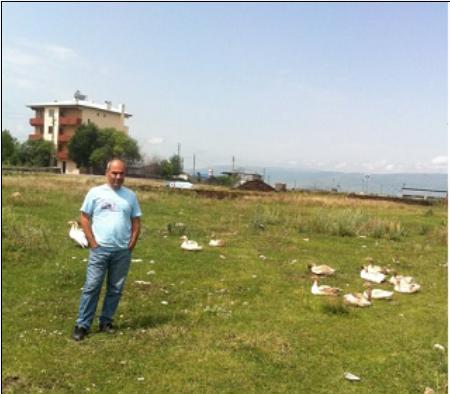
KAZ". Curiously, the following modern picture also shows sitting "yellow
geese"from eastern Anatolia which seems to verify this.
Furthermore, again from Wallis Budge's dictionary, we have the ancient Masarian
word "QESU" meaning "preserves
of birds, goose pens", [E.
A. Wallis Budge, "An Egyptian Hieroglyphic Dictionary", Volume II, p. 778a].
Surely, this word "QESU"transcibed
from hieroglyphs written in ancient Masar (Misir) is nothing but a form of the
Turkish word "KAZ
ÖY" (GAZ DAMI)meaning "goose
house" (goose-pen). The letter "E" in "QESU" is
an arbitrary vowel-filling when transcribing ancient "Egyptian" hieroglyphs into
Latin lettering.
In view of all this, it can be confidently said that in the ancient Masarian
("Egyptian") language, the name for "goose" was the same as the Turkish word KAZ
(GAZ) indicating that Ancient
Masarians were Turkish speaking Turanians!!! Most likely the ancient Sumerians
and Masarians, who were also Turanians, had a civilization that was a
continuation of the Göbekli Tepe civilization which lived in the Middle East
area some 6000 years earlier.
I must also point out that one of the Sun-God's names in ancient Turanian
language was O KÖZ, O GÖZ, OGUZ,
OKUZ. Theancient Masarian name "GAZ
God" fits right into this
category of Turkish names for the ancient sky-god deity. In fact, we see that
this GAZ (Goose) hieroglyphic
symbol is present in the cartouche titles of many ancient Masarian kings, that
is, PERU (PHARAOH). The name PERU is
the Turkish "BIR O" meaning "Only
One, the God" - while the supposedly Semitic name"PHARAOH" is
just an anagram of the Turkish name "BIR
O".
In my paper about the Göbekli Tepe findings, there is one stone that had the
carved picture of a bull, a wolf and a heron. I identified them in Turkish as
OKUZ (the bull, ox), as BÖRY (KURT) the wolf and as TURNA (heron) respectively.
I pointed out their sacredness in the Turanian culture. In addition to this,
there is another Göbekli Tepe stone that bears the carved picture of a lion.
Thus, I believe that the picture of a "scorpion" on
some stones was also a very important one in the context of their Sun-god
worshipping religion.
Since the names of Bull, Lion and Scorpion are associated with the zodiac names
at present, it is likely that these animal names were also associated with the
sky deities at the time of Göbekli Tepe civilization. This would make these
animal names and their images on stone as a form of communication among peoples
and also a way of passing on their religious ideas to each other and also to
future generations by carving their images on stone.
Furthermore, in ancient hieroglyphic writings of ancient Masar ("Egypt"), the
following transcribed words
are given:
The word ḤEṬṬ meaning "scorpion", ḤEṬṬIT meaning "the
scorpion-goddess",
and ḤEṬI meaning "the
flying sun-disk",[E. A. Wallis Budge, "An Egyptian
Hieroglyphic Dictionary, Volume I, p. 522a].
a) The word ḤEṬṬ can
be read as Turkish "AĞIDI-aDi" meaning "its
name is poison" which a
scorpion is.
b) The word ḤEṬṬIT can
be read as Turkish "AĞADI-ADI" meaning "his/her/its
name is Lord" which refers to
a "scorpion-goddess".
c) The word ḤEṬI can
be read as Turkish "AĞADI" meaning "it
is the Lord" which is the Sun
God.
Turkish word "AĞI" means "poison", AĞA means "Lord".
These readings show that words appearing similar in format can be read in
different ways with changing meanings where each reading may describe a
different concept in Turkish.
Again here, we see that the name of scorpion is associated with the Sky-God
deity the Sun. I believe, this view would also be valid in the case of the "scorpion
king" writing on ivory findings
of Abydos.
Presently, the Turkish name for "scorpion" is "AKREP". I
believe this name is an ancient name
for scorpion in Turkish.Interestingly, this name read from right to left is "PERKA" which
is a form of the Turkish expression "BIR
AKA" (BIR AĞA)meaning "One
Lord" which is a definition
of the Sky-God in Turanian civilization. Again, this shows that the name AKREP,
that is, "scorpion", was also associated with the name of God, hence it was
sacred. For that reason, one would
think that the "scorpion" was also included among the "zodiac" names
as is done presently. Thus, this insect was regarded as "sacred" by the
ancient Turanians because its name suggested a relation with the Sky-God and
Sun-God concepts. In this context, we must note that the use of scorpion is
very much like the sacred use of the black
dung beetle, (the so-called "scarab
beetle" or the "Scarabaeus
sacer") since it was also used as
an insignia of the Sun-God in
ancient Masarian (MISIR) religion. This "scarab" insignia was usurped from
Turanian Masarians by the Christian clergy and has been used up to present times
as a very important religious symbol, for example, as a Papal coat of Arms!
To add to our discussion, I would also like to dwell now on the name "scorpion"
and its variations. This
is because the name "scorpion" and its variations are embedded with a number of
Turkish expressions which are hidden from the eyes of "scholars" - and they are
very relevant to our discussion. Let
me show you what I mean by this:
The Greek name for "scorpion" is given as "SKORPIOS" and
is also in the form of SKORPAINA that
means "sea scorpion".
a) The Greek name SKORPIOS,
rearranged letter-by-letter as "OKROPISS",
is found to be an anagram of the Turkish expression "AKREPIZ" meaning "we
are scorpion". Thus, this definition in Turkish identifies this insect
with the Turkish nameAKREP indicating
that its ancient and original name was actually in Turkish, although, it has
been altered and anagrammatized into a supposedly "Greek" name.
b) Alternatively, the Greek name SKORPIOS,
rearranged letter-by-letter as "PIR-O-KOSS",
is found to be an anagram of a Turkish expression that has multiple meanings.
The deciphered name "PIR-O-KOSS" is
in the following Turkish forms:
a) "BIR-O
KÖZ" meaning "One
sky God is fire", where BIR
O is a name for the Sky-God and
the Sun-God.
b) "BIR
O KÖZ" meaning "Only
He is fire", that is, the
Sun,
c) "BIR
O GÖZ" meaning "Only
He is the Eye" which is again
the Sun because the sun was regarded as the "fire
eye of the Sky-God".
d) "BIR
OGUZ" meaning "One
Oguz" where OGUZ is
a name of the ancient Turanian Sky-God, Sun-God and Moon-god and is also an
ancestral name of the Turanian Tur/Turk/Oguz peoples, and
e) "BIR
OKÖZ" meaning "One
Bull (god)" which again
refers to ancient Turanian sky-deities as "Bull". It
is known that God concept was also identified with a bull personification in
ancient times.
Again these definitions of "scorpion"
in Turkish associate "scorpion" to all of the following: Sky-God;
Sun-God; Moon-God; the sacred ancestral God name OGUZ; God the Bull Oguz; and
the Tur/Turk/Oguz peoples of Turanians.
Now let us understand the Greek name SKORPAINA meaning "sea
scorpion".
a) First
of all, the Greek word SKORPAINA,
rearranged letter-by-letter as "SO-AKRAPI-N",
is found to be an anagram of the Turkish expression "SU
AKREPI" (SU AKREBI) meaning "water
scorpion" or "sea
scorpion". This definition in Turkish is in perfect agreement with the
given Greek definition, but it also shows that the name SKORPAINA has
been made up from Turkish insect name "SU AKREPI". So, initially, it was
in Turkish and also Turanian!
b) Additionally, the Greek word SKORPAINA,
rearranged letter-by-letter as "PIR-KONAS-A", is found to be an anagram
of the Turkish expression "BIR
GÜNEŞ O" meaning "it
is one sun" - which again
refers to the ancient Turanian Sun-God who is the source of light and heat for
everything in its corner of the sky. Thus, we find that this Turkish expression
also relates the scorpion name to the concept of SUN indicating that the
"scorpion" was regarded as sacred in ancient times and it was in the Turkish
language!
Turkish BIR means "one" and GÜNEŞ means "sun", SU means "water" and AKREP means "scorpion".
So these two decipherments of the Greek word SKORPAINA and
the Latin word SCORPION, show
that these names were actually made up from a Turanian linguistic source that
related this insect linguistically to the sun in ancient Turkish. This would
make this insect a sacred one in the eyes of the ancient Turanian peoples who
worshiped the sun. I say this would be one likely reason why they carved the
image of a scorpion on ancient stones, ivory or other medium - and also put it
amongst the zodiac names. Also, this
may be a pictorial way of communicating religious concepts among themselves as
well.
Of course, even the Latin names "SCORPION" and "SCORPIONIS"
provide us with similar results in Turkish.
c) The Latin word SKORPION,
rearranged letter-by-letter as "PIR-KONOS",
is also found to be an anagram of the Turkish expression "BIR
GÜNEŞ" meaning "one
sun". Turkish BIR means "one" and GÜNEŞ means "sun".
d) Similarly, the Latin word SKORPIONIS,
rearranged letter-by-letter as "PIR-KONISS-O",
is also found to be an anagram of the Turkish expression "BIR
GÜNEŞ O" meaning "it
is one sun".
These two Latin names verify that they were made up from Turkish and also that
they were associated with the ancient
Turanian Sun-God - which provides light and heat to all in its corner of space.
In this regard, if I may, I would like to suggest seeing my paper at url http://www.polatkaya.net/zodiac.htm,
where I discuss the zodiac names.
In view of all this, it can be said that the scorpion was regarded
as a sacred animal due to the fact that the names given to it related it to the
Sun God in Turkish - and that this fact was a means of religious communication
and knowledge transfer amongst people.
This also implies that the mono
syllabic Turkish language was the
most ancient and highly developed language of the ancient world - and that the
names of many things were already determined in Turkish and those names were
known to people in general in the world-wide language of Turkish. This
vocabulary included the names of people such as family members, people of the
community, animals of daily life and the names of environmental points of
importance such as mountains, rivers, lakes, seas, etc. and, of course, the
Sun, the Moon, the Earth and the Sky-God concept, that is, GÖK
TANRI in Turkish!
People can communicate with each other about things only if they have mutually
known names for things that they want to talk about. Without a name, no
concept, physical or abstract, can be explained. Thus, names are extremely
important in having a language and in communicating "knowledge" among people!
So, contrary to the rather vilifying views of modern
"scholars" about the ancient peoples, I believe that the ancient people were
just as smart as we are today, except that they solved their problems in
different ways with different technology.
Additionally, the Göbekli Tepe findings tell us that the ancient world was a far
more advanced civilization than what modern man thinks they were. Modern man
has been manipulated by some special interest groups of late religious
establishments to think that ancient peoples were just hunter-gatherers who knew
nothing else but that! Of course, this kind of "propaganda" would be for the
benefit of the newly established religions that never explained the true
identity of that which they are advocating people to believe. For them, the
secrecy of things (from people) was of primary importance as it would insure
their own security and enable the spread of their new 'religious' ideas under
the guise of mythological names and personifications that aimed to get rid of
the old world-wide religion of Turanians (based on sun, moon and sky-god
deities) and the knowledge that their ancestors produced. In order o erase that
ancient civilization so-called "paganism", they
said, for example, in
Isaiah 65:17 "For here I am
creating new heavens and a new earth; and the former things will not be called
to mind, neither will they come up into the heart". With
this kind of all dominating religious pronouncements, scholars were put under
restrictions in understanding the true picture of the ancient world.
In summary, these are my views regarding your questions. Thank you again for
writing and I wish you the best of luck in your studies of the ancient
civilizations and writings.
Sincerely yours,
Polat Kaya
Note: I will also put this discussion into my Polat Kaya library, my
polatkaya.net site and a few of my other sites. I hope you do not mind.
30/07/2011
Greg Stafford wrote:
Hello, Mr. Kaya:

My name is Greg Stafford and I study ancient civilizations and writings.

I want to first thank you for your writings and views on the findings at
Gobekli Tepe. I also wanted to ask you about the methods and means of dating
the findings, specifically, what material has been tested to determine the
proposed dates since, as I understand it, stone cannot be carbon dated. If
that is the case here, then what is it that has been so tested to arrive at
the 9,000 - 13,500 year old dates for the Gobekli Tepe stones?

Also, I have been studying the ivory tags found in the tomb at Abydos, some
of which show seated birds, which also appear to be shown on some of the
stones at Gobekli Tepe. Further, there are scorpions shown at Gobekli Tepe,
and also in the area surrounding the findings at Abydos, specifically, in
reference to the "Scorpion King." Typically, the ivory tag and other
findings at Abydos are seen as hieroglyphs. I wonder, then, if we also have
at Gobekli Tepe similarly "hieroglyphs, or if at both locations we have, in
fact, pictograms or image inscriptions communicating similar beliefs.

If you have time, I would greatly appreciate any information you can provide
on the carbon dating of the findings at Gobekli Tepe, and then also your
opinion on the possible link between what we see on the stones there in
comparison to similar images on the ivory tags and stone images found at
Abydos.

Thank you for your time and consideration to the above.


Best regards,

Greg Stafford