By
POLAT KAYA
Dear Aslam Rasoolpuri,
In this Part-2, I show that the Sumerian was most likely a dialect of
Turkish - if not the same.
There are many Turkish words in the Sumerian language and also in the
ancient Masarian (MISIR, that is, the so-called ancient "Egypt") language,
which is dated to at least 5000 years ago. Yet, none of the investigators
of these sources are giving reference to the name TUR or TURK or OGUZ.
These scholars knew about the name TROY, which
is from Turkish"TUR ÖY" meaning "home
of TUR / TURK / OGUZ" peoples,
but it was wrongly associated with the Indo-European people. The name TUR
/ TURK / OGUZ" has been intentionally suppressed up to now - particularly
by the Judeo-Christian readers of the ancient Sumerian documents.
For example, in reading the Sumerian texts, the god name "TUR" was
suppressed and replaced by "MAR". This is very clearly stated in a
footnote given in the book "A
Sumerian Reading-Book" by C. J.
GADD, Oxford At The
Clarendon, Press, 1924, page 48-49, footnote number III where it states: "TUR
is read mar in
the name of this god." This,
of course, erases the god name TUR from
the Sumerian texts and removes the Tur/Turk/Oguz peoples from ancient history
since TUR was
also the name for this Turanian peoples. It also transfers that magnificent
civilization of the Tur/Turk/Oguz peoples, that is, the Turko-Sumerians, to
the wanderer people of ancient Babylon. This is a very subtle way of
obliterating the history of one people while bolstering the history of another
group of people by way of stealing and altering the names, language, religion
and even the people themselves. It is known that the Babylonians stole
everything from the Sumerian civilization. Yet the Sumerians are now
presented as "extinct" people - having no relations to anybody - which is a
total falsehood because the Sumerians were one branch of the Tur/Turk/Oguz
peoples. The present day Tur/Turk/Oguz people are the inheritors of the
Sumerian legacy.
In the Sumerian texts, the name DINGIR meaning "GOD" is
found everywhere. Of course the word DINGIR is
nothing but the Turkish word DINGRI
(TENGRI, TANRI, TENGER, TENGERE, TANGARA) meaning "GOD". It
is almost certain that the Sumerian DINGRI
(TENGRI) was deliberately read
wrong in the form of DINGIR so
as to alienate it from its Turkish form of "TENGRI".
Additionally, DINGIR, in
the form of "GINDIR", is
nothing but a form of the Turkish expression "GÜNDÜR" meaning "it
is the sun". The Sun
indeed was the Sky-God of the ancient Sumerians as well as the rest of the
Turanian TUR / TURK / OGUZ" peoples throughout the world. It must be noted
that theDINGIR symbol in
Sumerian writings was a "star" symbol. And of course the Sun was not only a
star to the Sumerians, it was their God. >From this analysis, it is clear that
the Sumerian word DINGIR for
"God" is the same as the Turkish word TENGRI for
"God" . This is testimony that Turkish religion and Sumerian religion were the
same and both expressed their "God" concept the same way.
C. D. GADD, in his book [p. 62-63], has another footnote (No. 32) which reads
as: "gilga. Signs BIL.GA,
as in the GIS.BIL.GA.mis =
GILGA.mis, and cf. p. 13". Similarly,
on p. 69 of the same book , C. J. GADD reads one Sumerian text as "dingir
gis.bil.ga.mes" and
identifies it as Gilgamesh.
This says that the original Sumerian text signs "BIL.GA.MISH" have
been wrongly presented to the world in the form of "GIL.GA.MISH".
In other words, the original name was not "GILGAMESH" but was "BILGAMISH".
The name BILGAMISH is
a pure Turkish word that means "he
who has acquired knowledge" (he who knows). Additionally,
the name "GIL.GA.MISH",
if read in the form of "AGIL.GA.MISH",
reveals another Turkish expression that also means BILGAMISH.
In this case, the Turkish word "AGIL"
(AKIL) meaning "mind,
wisdom" , as opposed to BILGA
(BILGI) meaning "knowledge" ,
was used to come up with the name "GIL.GA.MISH".
The "GIL" in
""GIL.GA.MISH" is
the Turkish "AGIL" (AKIL) with
the front vowel droped. Additioanall, the "-MISH" at
the end of BILGAMISH and GILGAMISH is
a pure Turkish suffix. This takes the Turkish language back to at least 6000
years ago.
We must also note that the name BILGAMESH,
in the epic story of Bilgamish
(Gilgamish (Agilgamish)), is the personification of the accumulated
human knowledge that encompasses everything known by that time and, that total
knowledge is much more than any one person can master or know in his/her
lifetime. Hence, BILGAMESH was
a God. Actually the story
says that BILGAMESH was
two-thirds God and one-third human. But nevertheless it was a "God-like"
being that was enlightening, creating, thinking, speaking, singing, writing,
emulating, naming concepts, etc. that developed all human knowledge up to
present times. The ancient Turanians knew that all of these things that BILGAMESHrepresented
took place in the human "head"- which made the human head a "God-like" being.
That is why the ancient Turanians also worshipped the human "head"
(TEPE, BAŞand KAFA in
Turkish) as God. And
because of this, the "WORD",
that is, SÖZ and AGUZ in
Turkish, was reagarded as "god" and "was
with the GOD" since it was the
voice of the "human head" which
was "God-like". The "head" (tepe, bash) contained God given the natural
thinking machine that "human brain" was.
Probably because of the sacredness of the "human head", the ancient Tur/Turk/Oguz
peoples also worshipped their ancestors (ancestor worshipping culture). Thus,
although "man" himself was a mortal being, he was also a sacred being.
In the Sumerian epic story BILGAMESH
(GILGAMESH), there is the story of the Great
Flood in which the epic
character UTNAPISHTIM (also
identified by the later Babylonians as NOAH -
which is the altered form of Turkish "HAN
O" meaning "the Lord"), builds
a "boat" just before the supposed great flood and saves in it, his family
together with a pair of all the animals, thus saving them all from extinction.
I identify that mythological boat as
the "human head" (Tr.
ER TEPESI, ER BASI). In other words, there was no "real boat" made to do
such a venture, It was just a metaphore for the human "HEAD" where
all the names of the animals known at that time were stored and saved as"KNOWLEDGE", that
is, "BILGI" in
Turkish, for future generations. After all, the human head (Tr. TEPE)
is metaphorically like a "boat" which holds all that knowledge. It is said
that the boat of UTNAPISHTIM landed
on the top of a mountain called Mount Ararat. But tops of mountains are
called TEPE in
Turkish - just as the human head is called TEPE in
Turkish. Thus the ancient Turanians not only regarded the "human head" (TEPE)
as sacred, but also mountain tops (TEPE). It is not a coincidence that
temples where God is worshipped are called TAPI in
Turkish. This is also why most temples in the world are in the shape of a TEPE,
that is, in the shape of a pointy mountain top, such as the Sumerian
Ziggurats; Masarian Pyramids and Obelisks; Inca Aztec and Maya pyramids;
pyramids in China; Turkish Yurts, Kurgans, Minarets and Mosque domes;
Christian Church domes, steeples and spires; Indian Pagodas and Stupas. As
you can see, the Turkish language and the ancient Turanian religious
civilization are at the foundation of all these concepts - although it is not
advertised as such.
When the name UTNAPISHTIM (UTANAPISHTIM) is
rearranged letter-by-letter as "U-ATMN-PASHITI"
or "U-ATAMIN-PSHTI", I find the restructured form of the Turkish
expression:
"U ATAMIN BASHIDI" meaning "it
is the head of my creator father" which
refers to both the Sky Father
God (GÖK ATA TANRI) and also
the creator forefathers.
That is why the Turks not only worshipped the universal
Sky Father God but also their "ancestors".
Making monuments for their ancestors is a Turkish invention and is one of
their contributions to the world.
Additionally, "U ADAMIN
BASHIDI" meaning "it
is the head of man".
Here again, we clearly see that in the ancient Bilgamesh epic story, the
Sumerians deified the human head, which is capable of all kinds of creations,
just as "GOD" is
capable of all kinds of creations.
This Sumerian epic story is most likely older than 6000 years but its name is
unquestionably in Turkish. This means that when the Epic story Bilgamish (Gilgamish)
was being composed, the Turkish language was there. Most likely it was written
and/or narrated in a dialect of Turkish (which I call "TURKO-SUMERIAN") during
the Sumerian times. This also makes Turkish a very old language being fully
developed before Akkadians ever existed.
Another ancient mythological character, similar to Bilgamesh, was the
supposedly Greek name "HERAKLEUS" who
is supposed to overcome and perform almost "impossible" labours assigned to
him. The name HERAKLEUS was in fact nothing but the Turkish "ER
AKLI, US" expression defining
the Human head and the knowledge accumulated in it. Of course a human head
can perform seemingly impossible tasks (as we have all seen with the miracles
of modern technology, space travel, skyscrapers, air travel, internet, etc),
because the human head is a God-like entity. It can think and solve huge
problems and create things and name them. This fantastic God-like capability
of the human head can be used for good purposes and evil purposes as we all
see today. At this point, I would like to note that the so-called
"underdeveloped" peoples everywhere should become aware of this inherent power
of the human head and cultivate it by spending a major portion of their
resources to educate their young people with knowledge so that they too may
rise and prosper. People everywhere must understand that "knowledge" is power
and with it, any goal can be achieved. It must be noted that all achievements
of humanity, irrespective of being small or outstandingly large, have been
achieved with "knowledge".
Evidently, the ancient Turanians knew this huge value of knowledge. That is
why they personified knowledge with the name BILGAMESH.
People should also understand that if they waste any opportunity to acquire
knowledge and wisdom and mastery of language in their lfe time, then, it is
more than likely that others who have acquired knowledge and wisdom and
mastery of language will run and control their lives. To avoid such unwanted
situations, it should be the policy of governments to provide extensive
scientific education for all of their youth so that they may attain
all-valuable knowledge and wisdom, and with that, personal self-sufficiency
and independence from adverse forces . To read more about the true identity
of the name Bilgamesh and Heracles,
please also see my papers at urls:
http://tech.groups.yahoo.com/group/Polat_Kaya/message/318
http://tech.groups.yahoo.com/group/Polat_Kaya/message/319
http://tech.groups.yahoo.com/group/Polat_Kaya/message/321
http://www.polatkaya.net/Heracles_Part-1.html
We must note that this ancient God concept had the name of TUR and OGUZ -
which are also the names of the Tur/Turk/Oguz people. We are all told that God
created "man" in his own image but it is most likely that the ancient Tur/Turk/Oguz
man created the God concept in his own image because it was man's head that,
after much observation of the sky and the earth, first conceived the "God"
concept. This is why the Turko-Sumerians and the Turko-Masarians regarded
the Sun and the Moon as the eyes of the Sky-Father-God. They must have
envisioned the invisible God as having a human-like
head of which the sun and the
moon were "His eyes" and the Sky was "His Face". The term "SKY" is
also expressed by the Turkish term "GÖK
YÜZÜ" meaning "sky
face" or "Sky
God's face".
Here I want to introduce another related subject. "The Sky-Disk of
Nebra" is an ancient
artifact found in what is presently called Germany. It was first brought to my
attention by Dr. Erhan Berber, some 2 years ago. Below is a picture of the
Sky-Disk of Nebra and below the picture is a sample explanation from some
people who have studied it - along with some links to further related sites.

"Sky-Disk of Nebra"
(See also: Sky
Disc of Nebra - The World's
Oldest Star Map
This is an exact, full-sized replica of the disc recently discovered
within a Neolithic woodhenge observatory near Nebra, Germany. The original,
bronze with gold plated stars, shows several constellations, including The
Pleiades, which can be used to predict the timing of the autumn harvest and
lunar eclipses. Symmetrical arcs at the sides mark sunrise and sunset on the
solstices and equinoxes. In the center are a crescent and a full moon.
Scholars have not yet deciphered the symbolism of the remaining arc, which
could represent a ship with oars sailing the celestial seas, or perhaps
served as a sundial. [1600 B.C.E.],
The picture of the Nebra Disk, as a representation of the of the human face is identified with two eyes and a smiling mouth, two ears and a freckled face. The stars represent the "freckle" spots on the face. Unquestionably, this ancient disk is a pictorial explanation of the ancient concept of the Sky-God and his relation to the "human head" as thought of by the Turanian Tur/Turk/Oguz peoples. Thus we have verified the concept of the Sky-God, Sky, Sun, Moon, Stars, Earth, Man and his creative and speech-making head and their relations to each other. The picture also shows the EYE/MOUTH (GÖZ / AGUZ) relationship, that is, the Sun and sunlight as God's eye and enlightenment in one hand, vs the human eye enlightening the human brain which evaluates and generates new knowledge and wisdom that is expressed through the mouth in the form of words and speech as further enlightenment. In other words, the Sun enlightens the earth with its light, thus enabling man to acquire knowledge about his environment and, in turn, man reprocesses this knowledge to create wisdom (Turkish "US"). That accumulated knowledge and wisdom is BILGAMESH. Knowledge is not learned and or created in darkness which is also the ignorance.
With all of this, it is no wonder that in ancient Turkish, the SUN and the MOON were also called by the name "GÖZ" in addition to GÜN and AY respectively.
In the above picture of the Nebra Disk,, I want to highlight the position of the six stars encircling ONE star at a position that corresponds to the forehead of the human face. That circle with a 'dot' at the center is the "Sun", that is, "The Sky-God's Eye" which ancient Turanians worshipped. This is indicated as a 'third eye' in the forehead of Turanian Tur/Turk/Oguz peoples' tombstones found in Central Asia. This is also shown by an "orange" or "red' (AL) dot put on the forehead by Indian women. Turkish peoples did the same by calling themselves as "AL BAŞ" (KIZILBAŞ, KIZIL TEPE, KIZIL ALMA, ALEVI, ALEV, etc.," all of which represented the Sun, Moon and the Sky-God. On the top of it, Turks even called themselves by the name GÖK TÜRKS meaning the SKY-TURKS. Clearly, all of this is the sign of respect and adoration shown to the God concept in ancient Turanian religion.
At this point I want to show two pictures of Turkish yurts of Central Asia.
(Yurt pictures are from Dr. Metin Gunduz). The appearance of the yurts show
them to be physically like a "hill" or "mountain" (i.e., tepe or bash in
Turkish). Yet internally, it resembles the sky dome, with an "eye" opening at
its top (tepe). This circular opening is a likeness of the "Sun" and its light
rays represented with the physical wooden structure. Just as the Sky dome is
a one "room" space above, the Turkish yurt is also a "one room dwelling", that
is, "BIR GÖZ DAM" in
Turkish using almost the same terminology as used to describe the sky. The
Turkish YURT was the model for the construction of the Pantheon building
in ancient Rome. In the case of the Pantheon, the single circular opening at
the top was called by the Latin name OCULUS meaning "EYE" or "the
DEMON'S HOLE". OCULUS is
infact made up from the Turkish expression "ULU
KÖZ" (ULU GÖZ) meaning "The
Great Fire" and "The Great Eye" which
refers to the sun. See my paper on Pantheon at urlhttp://www.polatkaya.net/pantheon_yurt.htm.
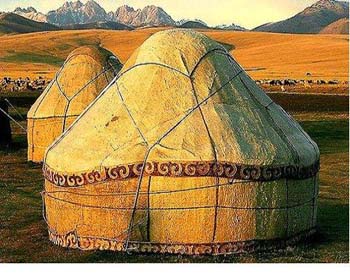
(Yurts from Central Asia- they are shaped like a "MOUNTAIN-TOP" or "MOUNTAIN-HEAD", that is, "TEPE" or "BAŞ" in Turkish. The Yurts also resemble traditional ancient Turanian conical hats).

Internally a Yurt resembles the sky-dome (Tr. Gök-Yüzü). The circular
opening at the top is an EYE, (Tr. "GÖZ")
which is an emulation of the "Sun" where the light rays are represented with
the physical wooden structure.
This makes the Yurt a "Tepe Göz, a name that we find in Turkish "Oguz
epic stories".
These are evidences that the ancient Turanians lived the trinity Sky God,
Sun-God and Moon-God concepts in many aspects of their lives and this is still
going on. They envisioned the Sky-God in the image of "man" and also "man" in
the image of the Sky God. Like the envisioned Sky God, man has a head and a
face with eyes and a mouth - and he has knowledge and wisdom.
All of this also shows that the ancient Turanian
Sky-God, Sun and Moon trinity religion was probably the first fully organized
and well thought out religion of the world in which the universe, sky, sun,
moon, earth, and man with his all-creative head and language were all thought
out in a unified creation concept of the universe. Turkish OGUZ
KAGAN epic story tells us about
his six sons named GÜN HAN (Sun
Lord), AY HAN (Moon
Lord), GÖK HAN (Sky
Lord), DAG HAN (Mountain
lord), DENIZ HAN (Sea
Lord) and YILDIZ
HAN (Star Lord).
This is one epic story that encompasses universal concepts. The Turkish
language was developed uniformly and coherently with the ancient Turanian
religion. The religion provided thought provoking
concepts and the Turkish language was created and developed to express all of
those amazing thoughts of human creation in a harmonious and coordinated
manner. The social behaviour of the Turanians was also coordinated within
these universal concepts. It might be said that like the Turanian sky-god
religion, the Turkish language was also probably the first uniform, as if
mathematically formulated and religiously coordinated language.
That is why it was the "SUN
LANGUAGE", "GÖZ LANGUAGE", "OGUZ
LANGUAGE" and the "TUR/TURK
LANGUAGE".
Best wishes to you and to all,
Polat Kaya
Will continue in Part-3
20/03/2008