
THE
AFTER THE TURKISH
'YURTS' IN
(Yurt, in addition to being a dwelling, was also a symbol of the ancient Turanian Sky-God religion)
BY
POLAT KAYA
(Copyright ©
Polat Kaya
June 04, 2006)
Table of Contents
The title above may be a startling one for some people who are not used to hear such bold descriptions of supposedly "Christian" monuments. The fact is that it is true! In this article I want to reveal a new insight regarding the identity of the ancient Pagan temple, so-called PANTHEON, in Rome. The ancient European native population was the so-called "Pagan" Turanians before the spread of Christianity. They were the followers of their ancient Turanian Oguz religion. This magnificent building called PANTHEON in Rome is an embellished copy of the Turkic YURTS of Central Asia. For the "Pagan" Turanians of ancient Europe, this is a natural outcome since for them, the YURT is a father-and-mother home, a country, and a sacred place. Without question, it was the ancient Turanian Tur/Turk peoples that were the followers of the world’s first trinity Sky-God concept comprising of one universal creator Father-God (ATA TANRI), the Sun-God and the Moon-God. The Turanian Sky-God concept, together with the Turkish language, was in world-wide usage before other religions were formulated and spread. The Judeo-Christian religions, while taking all of their tenets from the Turanian OGUZ religion, also vilified not only this ancient so-called "Pagan" religion, but also its followers to the degree of annihilating them. In this essay, I have collected together many widely-spread and confused parts of an ancient puzzle to compose a picture that shows how the most advanced civilization of the ancient Turanian Tur/Turk peoples was stolen and obliterated.
Graham Speake writes the following about the "Roman" temples: [1]
"Temples:
The earliest Roman temples followed the Etruscan model: a flight of steps at one
end led to a PORTICO on a raised platform behind which was the CELLA. The
addition of columns, either free-standing or engaged, along the sides and
sometimes at the end was due to Greek influence. Internally, from the first
century BC a domed apse was often placed on the back wall of the cella. The
finest surviving of such a temple is the MAISON CARREE at Nimes (Nemausus) (c.
16 BC).
Circular temples were popular from an early date, their form derived from the
Greek THOLOS. The so-called temple of VESTA in the Forum BOARIUM dates from the
late second century BC and is the oldest marble temple in Rome to survive. The
culmination of this form is seen in the PANTHEON, built under Hadrian, where
unparalleled attention is devoted to the proportions and decoration of the
interior.
It
is the eastern provinces, where Rome found difficulty in making any impact on a
thoroughly Hellenized culture, that the monumental scale of temple architecture
is best observed. The temple of BEL at PALMYRA and the precinct of Jupiter at
BAALBECK where columns stand to a height of 65 feet, have more to do with
imperial propaganda than with religion."
This tells us that the earliest
so-called "Pagan" temples in Italy were made by Etruscans, that is, a Turanian
Tur/Turk people whose Turanian identity somehow has been denied by western
writers. Referring the source of such domed buildings to Greek is not truthful.
In fact, it is plainly wrong. Ancient Greeks themselves owe what they achieved
in architecture and artistry to the "Pagan" native Turanians of the ancient
world. When the ancient wandering Greeks (Latin Graecus, Greek Graikos, Turkish
Garachi (Gara-aichi)) first arrived at what is now called Greece, they had
nothing of their own to boast about. There was already a native flourishing
civilization of so-called Pelasgians who were Turanian people. Those ancient
Greeks learned everything from the native Turanians and when they had the
opportunity, they destroyed the old culture of the native peoples and built on
the ruins, new structures (copied and embellished from the native Turanians)
that they call their own. The so-called Greek columns are not Greek in origin.
They are copies from the native peoples culture.
The columned "PORTICO", that is, the "entrance to the temple building" was
originally Etruscan. The name PORTICO, when rearranged letter-by-letter as "COPITOR",
is the Turkish word "KAPITUR" meaning "it is gate", "it is door", "it is
entrance". Thus the so-called Latin word "PORTICO" is not Latin in origin at
all but rather Turkish in origin. This further identifies the PAGAN temple
PANTHEON as a building by Turkish speaking Turanians contrary to all the
disinformation to which the public has been subjected to.
Circular buildings and/or temples with a "DOME" are the Central Asiatic YURTS.
The above citing tells us that these ancient Pagan temples were circular and/or
semi-circular single room buildings with a dome on it which means that they were
fashioned after the Central Asian YURTS. The VESTA of Forum BOARIUM is such a
round temple. See URL: http://en.wikipedia.org/wiki/Image%3ABoariumlauvernier.jpg
Photograph of Boarium Forum, Rome by D. Lauvernier
where two circular temples with a domed roof are observed
in the lower
right quadrant of the picture.
Below is a close-up of one of the two temples from:
http://en.wikipedia.org/wiki/Image%3ATempleOfHercules-ForumBoarium.jpg

TempleOfHercules-ForumBoarium.jpg
The Latin term "VESTA" is defined as "the goddess of the hearth and domestic life. [2] Webster’s Dictionary defines it as:
"The goddess of the hearth and its fire, and hence cookery. Her temple symbolized the hearth of the city and contained a fire, rekindled on the day (March 1) beginning the new year, by friction of the wood and in charge of the vestal virgins. See HESTIA". [3]
The English term "hearth" corresponds to Turkish "OCAK, YURT, AILE OCAGI". The goddess of "hearth" is the personification of family fire which is evident from the name VESTA. VESTA, when rearranged as "ATES-V", is from Turkish "ATES O" meaning "it is fire" or "ATES OY" meaning "it is the fire of home" which is the "hearth".
HESTIA is the Greek version of
goddess VESTA. When HESTIA is rearranged as "ISETAH", it is the Turkish
expression "ISITI" (ISITIR) - meaning "it is heat", "it heats". Additionally,
when HESTIA is rearranged as "ISHETA", it is the Turkish expression "ISHITI"
meaning "it is light", "it is flame" and "it lights up". Finally when HESTIA is
rearranged as "ATESHI", it is the Turkish expression "ATESH" meaning "fire". In
Azerbaijan Turkish dialect, ISTI (isti, ISITI) means "hot, fire, flame".
Thus in all of these cases, reference is made
to fire, light and flame in Turkish and both names of the personified goddesses
VESTA and HESTIA have origins in Turkish contrary to "known" explanations.
In any home, the "fireplace" (hearth) is always the center of attraction. As long as the fire place burns, it provides heat and light, and opportunity for the family to cook and eat implying that the family is alive and well. This concept is expressed in Turkish as: "ocak yanip duman tüttügü sürece, aile devam eder" meaning "as long as the hearth burns and the chimney smokes, the family lives on". So the ancient temple VESTA of Forum BOARIUM is a temple of fire which had a fire going on inside. These ancient circular pagan temples resemble the YURT of Turanian Tur/Turk peoples in Central Asia since YURTS are such dwellings. Thus temple VESTA is again a replica of the Turkish YURT in which a family (aile ocagi) lives, and also in the middle of which there is a hearth (ocak). The YURT is an emulation of the Sky-Dome (GÖK DAMI) by the ancient Sky-God worshipping Turanians.
The name Forum BOARIUM is described as the "cattle-market of Ancient Rome". See URL:
http://penelope.uchicago.edu/Thayer/E/Gazetteer/Places/Europe/Italy/Lazio/Roma/Rome/_Texts/PLATOP*/Forum_Boarium.html
The Latin word "FORUM" is defined as
"an open square, a market place; Forum BOVARIUM or BOARIUM, the cattle market, FORUM HOLITORIUM, the vegetable market, etc." [4]
This bit of information about ancient Rome is also very interesting to us because the term "BOARIUM" is an anagrammatized word from Turkish.
First of all, the word BOVARIUM has embedded in it the Turkish word BOA (BOGA) meaning "Bull" or "cattle". Secondly, when the word BOVARIUM (BOARIUM) is rearranged letter-by-letter as"BOA-VIRUM", where V=Y, it is the Turkish expression "BOA YIRUM" (BOGA YERIYIM) meaning "I am bull place", "I am cattle place", "the bull market" or "the cattle-meat market"; in another meaning, it means "I eat cattle (meat)". The English term "meat" has embedded in it, the Turkish word "ET" meaning "meat". Additionally, if English MEAT is rearranged as ETAM, it is Turkish "ETEM" (ETIM) meaning "I am meat" where Tr. ET means "meat").
Firstly, this term HOLITORIUM meaning "vegetable market" has embedded in it the Turkish term "OTLUH" (OTLUK) meaning "vegetables" an/or "plants". When the Latin term HOLITORIUM is rearranged as "OTLUH-UIRIM" where the bogus letter U = Y, it is the restructured and disguised form of the Turkish expression "OTLUK YERIM" meaning "I am the place of plants", that is by another name, "I am vegetable market". In Turkish, terms such as "OT PAZARI", "OT MEYDANI", and "OT YERI" were used in Eastern Anatolia in Turkey. Additionally HOLITORIUM has embedded in it the Turkish word "HAL" (HOL) meaning "covered fruit-and-vegetable market" supposedly having been imported from French.
It appears that the addition of the word "FORUM" to these expressions is redundant and provided as distraction.
All of this connects ancient Rome with Turkish speaking native Turanians. It is known that Rome was founded by the Etruscans. These close Turkish correspondences in BOVARIUM and HOLITORIUM are not coincidental since the natives of early Italy were the Turkic speaking Turanian peoples. Evidently the Turkish language of the natives has been pirated by way of anagrammatizing into Latin and Greek and all other Indo-European and Semitic languages.
Greek word THOLOS means "dome,
cupola, and vault". [5]
First of all, this so-called Greek word THOLOS has embedded in it the Turkish
word TAS meaning "bowl
with a rounded bottom". Additionally,
when THOLOS is rearranged as "OLH-TOS", where Greek H=I, it is the Turkish
expression "OLI TAS" (ULU TAS, ULU
KAB) meaning "great
bowl with a rounded bottom" which
is another description in Turkish of a "dome" (a rounded roof) or Turkish "DAM"
meaning "roof". The expression "Great Roof", "Great Dome" also refers to the
Sky-Dome which is the "great circular roof" above all of us.
In the ancient Turanian "Sky-God" religion, SKY (Tr. GÖI or GÖK) was one of the
most important elements of the religion. That is why one of the six sons of OGUZ
KAGAN was named "GÖK HAN" meaning "Sky-Lord". The Turkish YURT having a circular
dome (Tr. DAM) above it is an attribute to the "SKY-DOME" (GÖK DAMI).
The name PANTHEON has
been the subject of an interesting modern book entitled "Angels
and Demons" by author Dan Brown.
[6] The name of the book appears as "Melekler ve Seytanlar" in Turkish
translation. After recently reading this book, I could not help but be attracted
to the name PANTHEON and its implications. Surely
many people read this very interesting book but most read it rather
superficially without knowing the hidden story about this famed building.
It has been used as a Church for the Catholic religion. Presently, it is one of
the tourist attractions of the city of Rome which itself was built by the
Etruscans before the Latins seized it from them.
This article is the result of my interest in this so-called "PAGAN" temple after
I read the book by the famed author Dan Brown.
The ancient building of Pantheon in Rome is said to have been rebuilt in Rome during the period 120-126 AD under Emperor Hadrian. The name PANTHEON is defined as [7]:
"[Latin, from Greek "pantheion" (sc hieron), from "pantheios" of all gods, from "pas", "pan" all + "theios" of the god, from "theos" a god.] 1. A temple dedicated to all the gods; especially the building so-called at Rome. 2. A building resembling or likened to the Roman PANTHEON; especially a building where rest the famous dead of a nation. 3. The aggreagate gods of a people."
Greek PAN, PANTOS,
PAS, PASA means "every;
everybody, everyone; all".
[8]
The source for this etymology is false as usual. It wrongly ties the source to
Greek and/or to Latin languages which are manufactured languages from the
Turkish of the so-called "Pagan" Turanians. The Greek and Latin languages did
not exist when Turkish was a world-wide language in the ancient world.
The name PANTHEION supposedly meaning
"of all gods", when rearranged letter-by-letter as "POTIN-HEN-A", is a
restructured form of Turkish expression "PÜTÜN HAN O" (BÜTÜN HAN O) meaning "it
is all God" which gives the exact correspondence with the above given meaning.
Turkish word "BÜTÜN" means "everything, everyone, all", "HAN" means "lord, god"
and "palace" while "O" means "he/she/it".
Similarly, the "ALL" meaning attributed to the Greek word "PANTOS" and "PAN"
would come from a Turkish source as follows:
First of all, the Greek word PANTOS has embedded in it the Turkish word BUTUN
meaning "all". Secondly, when PANTOS is rearranged letter-by-letter as "POTNAS",
it is found to be a restructured form of Turkish "BUTUNUS" (BÜTÜNÜZ) meaning
"we are all" which again provides the exact correspondence with the meaning
attributed to PANTOS.
Evidently PAN is a shortened version of PANTOS. Additionally, the word PAN is
very much another form of Turkish "BEN" (MEN) meaning "I", that is, the personal
pronoun for first person singular in Turkish. Furthermore the Greek word PAS
meaning "all" is very much Turkish word "BAS" meaning "head" which is owned by
all living beings. In this context, the words PAN and PAS meaning "me and my
head" refer to "man", that is, in general to everyone. But the term "PAN" (BEN,
MEN) is also related to the so-called mythological god name "PAN" (PANOS).
Mythologically, there is the "Greek" nature-god "PAN" or "PANOS" defined as: "A
god of flocks and pastures, forests and their wild life, patron of shepherds,
hunters, etc. Pan was presented as having the legs and sometimes the ears and
horns of a goat." [9]
This half-man and half-goat representation of God is another representation of
the ancient Turanian Sky-God OGUZ with a "Bull" (OKUZ) icon like the
mythological "MINOTAUR".
The PANTHEON is described as a "PAGAN" temple. The term PAGAN is defined as:
"1. One who is neither Christian, Jew, nor a Moslem; a heathen. 2. Early Christian use, a idol-worshiper; a non-Christian. 3. An irreligious person; adj. Pertaining to Pagans. Latin "PAGANUS" meaning "heathen", a rural villager, country man". [10]
In the context of Europe, the correct
meaning of this definition is that they were the native farmers, the country-man
of ancient Europe. In other words, they were the sun, moon and creator
Sky-Father-God worshipping native Turanian peoples, that is, the so-called
"Latin" countryside people which antedated the Aryans (arayanlar, gezginciler,
karaçilar). This definition of PAGANUS is a pejorative one vilifying not only
the ancient Turanian peoples but also the ancient Turanian religion in order to
spread Christianity into the ancient "Pagan" Europe. In order to prove the view
that this people were Turkish speaking Turanians, let us examine the Latin word
PAGANUS meaning "the country man".
a) The anagrammatized term PAGANUS,
when rearranged letter-by-letter as "SAPANGU", is
the restructured and disguised form of the Turkish expression "SAPANCU" meaning "he
who uses plough". But of course
it is the farmer or the country-man that uses the SAPAN (plough). The Turkish
word "SAPAN" means "plough" and the Turkish suffix "-GU/-CU" defines a
profession. Thus "SAPANCU" means "one who uses plough" which is another way of
defining a farmer and/or a countryman. Thus the source for this PAGANUS (PAGAN)
concept is pure Turkish and is stolen from Turkish. This is another testimony
that the Aryan Europeans not only stole the Turanian Turkish language in
manufacturing Indo-European languages but also all the civilization defined by
the words of that Turanian language. This sin of the Europeans must be the
reason for their continuous vilification of the ancient and modern Tur/Turk
peoples.
b) In addition to the above
meaning, when the word PAGANUS is
rearranged letter-by-letter as "PA-GUNAS", it
is the anagrammatized form of Turkish expression "APA
GÜNES" meaning "Father-Sun", that
is, the "creator sun". It is a known fact that the so-called PAGANS worshipped
the Sun.
c) Furthermore,
PAGANUS when rearranged as "PAN-A-GUS" is
from Turkish expression "BEN O GOZ" meaning "I
am that Eye" referring to Sun and
also from Turkish expression "BEN
OGUZ"meaning "I am OGUZ" which refers not only to the ancient Turanian "OGUZ"
(TUR) peoples, but also to their Sky-God OGUZ and AGUZ meaning "the
word, language, mouth". This of
course identifies the ancient Turanian religious concept of OGUZ and AGUZ. Where
OGUZ is the Sky Lord and AGUZ is the WORD of OGUZ – which was the Turkish
language.
All of these expressions identify the term PAGANUS with the ancient Turanian Tur/Turk
peoples, their Sky-deities and their Turkish language. This also means that the
ancient world was a Turkish speaking world with their Sky-God Oguz religion
being followed all over the world until the wanderer groups instigated to change
and destroy it.
Greek word EIDWLOLATRHS, (where the letter H = I or E), meaning "pagan, heathen, idolator". [11] The Greek word EIDWLON meaning "idol, image".
The Greek term EIDWLOLATRHS, when
rearranged letter-by-letter as "AL-OD-EWLITHR-S", is the restructured form of
the Turkish expression "AL OD EVLIDIR" meaning "they are from the house of
glowing red-fire worshippers", that is, "they are from the house of Sun
worshippers".
Similarly, there is the Greek word EIDWLOLATRIKOS meaning "pagan, heathen, idolatrous".
The term EIDWLOLATRIKOS, when rearranged letter-by-letter as "OKUS-TUR-AL-OILEDI",
is a restructured form of the Turkish expression "OGUZ-TUR AL ÖYLÜDÜ" meaning "OGUZ-TUR
(people) are from Red house", that is, "OGUZ-TUR people are Sun worshippers".
The ancient Turanians personified their Sky deity (Gök Tanri) in many forms with
many differing names and that is why "God has many names".
Personifying the "Sky-Deity" in some iconic forms, so-called "idols" was how the
ancient so-called "PAGAN" people identified with "God" as god influenced all
aspects of their life. Having icons of their God near them, in their homes,
around their necks as amulets etc., gave them physiological security and
closeness to their God and his "protection". There is no difference between this
kind of personification of their sky deities and the performing of rituals to
them by the ancient "Pagans" and the present day Christians kneeling in front of
a Jesus-laden-cross and praying to this "cross-idol" for their wishes to come
true. So the same ancient Turanian rituals are still going on but in a
different form. Although the founders of the later religions have conned their
followers for the last 2500 years, let no verbology or sophistry con the present
day people otherwise.
We may recall that The Turkish State of Azerbaijan is also known by the name
"Land of Fire". The "Greek" mythological God "PROMETHEUS", that is, from
Turkish: "BIR-O METE OGUZ", is said to have given fire to humanity. For his
generosity, the "Greek" God ZEUS, which is also from Turkish "SÖZ" meaning
"WORD", got angry and had Prometheus chained to the Caucasian mountains where an
eagle would torture him daily. Caucasia has always been a land of Turanians,
until some of them were converted to Judeo-Christianity and their Turkic
identity was lost.
Related to the name Pantheon is the
word "PANTHEISM" defined as: "The doctrine that the universe, taken or conceived
of as a whole, is GOD." [12]
This definition equating GOD with the universe is another common Turkish belief
and tradition that "GOD is everywhere and in everything" (Tanri her yerdedir ve
her seydedir).
The word PANTHEISM also has embedded in it the Turkish phrase "BÜTÜN- ISIM"
meaning "all names", which of course includes everything in the universe that
has been named and can be named. Back in the so-called Pagan times, such as the
eras of the Turanian Sumerian or the Turanian Masarians and others, everything
was being named in the OGUZ language, that is, the Turkish language.
After giving all of this background information now let us examine the
word PANTHEON as a ‘temple".
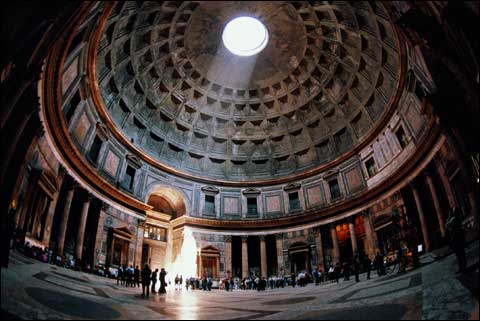
Above is a view from inside of the pagan temple Pantheon from URL:
http://www.monolithic.com/thedome/pantheon/pictorial8.html
The above picture shows the famed OCULUS of the PANTHEON building. Clearly, it is a replica of the Turanian YURTs. The hole at the top (called the Oculus) provides light into the building. When this building was built by the "Pagans" of ancient Rome, the Oculus symbolized the Sun - and it still does now. In the same way, the Sun provides light into the 'Sky Dome' above the earth. The dome of the PANTHEON building symbolizes the sky-dome. Furthermore, the Oculus symbolizes the SUN as the seeing and glowing-fire eye (Turkish "KÖZ GÖZ", "KOR GÖZ" and "GÖR GÖZ") of the ancient Turanian Sky-God. When the PANTHEON building is viewed from above, what one sees is a prominent "Eyeball" structure. Similarly, when one views the PANTHEON dome from the inside, what one sees again is an "Eye" structure. Of course the English word EYE" is nothing but a distorted and disguised form the Turkish word "AY" meaning "Moon" - which was also regarded as an "EYE" of the ancient Turanian Sky-God OGUZ. A bird's eye view of the Pantheon is given below, courtesy of Google's "Earth" program. Clearly and unquestionably, the Pantheon, as a "Pagan" temple, symbolizes the Sun as the "EYE" of the universal Sky-Father-God - and also, the eye of the human being. By another interpretation, it is a three dimensional symbol of the name "O-GÖZ", that is, the Sky-God "OGUZ" of the ancient Turanian so-called "pagan" civilization which has been deceptively usurped by the Christian church.

The Pantheon in Rome as viewed above from an earth satellite.
This picture is from Google's "Earth" program.
Being a religious term, it has a
number of meanings embedded in it as we will see below.
1. PANTHEON, when rearranged letter-by-letter as "N-TAPENOH", reveals
the Turkish expression "aN-TAPINAH" (GOK TAPINAK) meaning "sky temple". This
explains the Pantheon’s temple aspect in Turkish. AN means
"sky" and "TAPINAK" means "temple". But
additionally,
2. PANTHEON, when rearranged letter-by-letter as "N-TAPE-HON",
reveals the Turkish expression "aN-TAPI HANI" meaning "sky worship house" which
of course is a "temple". Turkish "TAPI" means "worship". The PANTHEON in Rome is
one such place. This new understanding of Pantheon with its embedded Turkish
expressions identifies and connects the ancient Turanian Tur/Turk peoples with
the so-called "Paganism.
3. Furthermore, when PANTHEON is rearranged letter-by-letter as "TEPA-HONN",
it reveals the Turkish expression "TEPE HANIN" meaning: a) "it is your head
palace" referring to the human "head" as a "temple" of the human body; and b)
"it is your sky-dome temple". Turkish "TEPE" ("BAS") means "head". In ancient
Turanian religious thinking, the human head, that is, the brain that is housed
in the head and that did all of the creating, was also a temple to be
worshipped.
Thus again the ancient Turanian "Sky-God" religion makes God and its temple as
parallel to man’s head and body. That is why it is said that God created man in
his own image. But this statement, when reversed, is also true, that is, "man
created GOD in his own image" since it was the human mind that conceived the GOD
concept and embellished it to its most prominent dimensions at present. All of
this was originally done in the Oguz (Turkish) language by the Turanians.
4. PANTHEON, when rearranged letter-by-letter as "PEN-OT-HAN, reveals
the Turkish expression "BEN OD HAN" meaning:
a) "I am the Fire Lord" representing the "Sun" and "fire";
Hence the temple PANTHEON is a temple dedicated to the ancient Turanian
"SUN-GOD". The circular opening at the top, that is, the "OCULUS" represents
the "sun" as this opening is the only light giving source to the inside of the
temple, just as the sun is the most prominent light giving source into our
region of the "sky dome".
b) "I am fire house".
It also represents such paganic shrines in which there was a continuously
burning fire. The Turkish expression "PEN
OT HAN" also means "I
am the Fire Palace" or "I
am the Temple of Fire" or "I
am the fire place", that is, "the
hearth" (Tr. Ocak). Thus again it represents the Sun, fire, the fireplace
and fatherhome or fatherland (home and country).
Thus it is seen that the name PANTHEON is a composite and anagrammatized word
comprising more than one meaning in Turkish all embedded in one
word.
A well presented writing is provided online by Freda Parker, entitled "The
Pantheon-- Rome -126 AD", A temple to all gods". For a description and history
of the Pantheon building in Rome, see URL:http://www.monolithic.com/thedome/pantheon/pictorial2.html
Will Durant writes: [13]
“The Roman family was both an association of persons with things and an association of persons and things with gods. It was the center and source of religion, as well as morals, economy, and the state; every part of its property and every aspect of its existence were bound up in a solemn intimacy with the spiritual world. The child was taught, by the eloquent silence of example, that the undying fire in the hearth was the sign and substance of the goddess VESTA, the sacred flame that symbolized the life and continuity of the family; which therefore must never be extinguished, but must be tended with "religious" care, and fed with a portion of each meal. Over the hearth he saw the little icons, crowned with flowers, that represented the gods or spirits of the family: the LAR that guarded its fields and buildings, its fortune and destiny, the PENATES, or gods of the interior, who protected the accumulations of the family in its storerooms, cupboards, and barnd....."
This description of Roman life is very much the description of the family life
of Turanian Tur/Turk peoples who were the native populations of Europe before
the Aryans (ARAYANS = WANDERERS) took over the land.
We have already explained VESTA being the goddess of "fire" in the hearth (ocak).
LAR was the Etruscan protective God which, in my view, stands for Turkish "AL
ER" meaning "The Red Man", "The Red Being". Even PENATES is a restructured form
of Turkish "BEN ATES" meaning "I am fire" which refers to the FIRE-GOD, that is,
the Sun.
Will Durant, referring to emperor HADRIAN, writes the following about the
PANTHEON, [14]:
"His most famous reconstruction was the Pantheon-the best preserved building of the ancient world. The rectangular temple reared by Agrippa had been destroyed by fire; apparently only the Corinthian portico remained. North of this remnant Hadrian had his architects and engineers raise a circular temple, in the most indigenous of Roman styles. ....... At the top of the dome an opening (the OCULUS, or "eye"), twenty-six feet in diameter, gave the interior its sole and sufficient illumination. From this majestic dome, the largest in history, an architectural lineage descends through Byzantine and Romanesque variations to the dome of St. Peter’s, and that of the Capitol in Washington."
Indeed the rotundas of the great
buildings of St Peter’s Basilica (the name BASILICA is from Turkish "BAS KILISE"
meaning the "Head Church") in Rome and that of the Capitol in Washington D.C.
are extremely embellished forms of the Turkish YURT. They are also the models
for most of the domed religious and state buildings in Europe and the United
States. Their "domes" represent the ancient concept of Sun and Moon being the "EYE"s
of the Sky-God. They all have an elaborate "EYE" design at the top of the dome.
Of course the Turkish mosque domes are also the same, that is, when viewed from
inside, an elaborate "eye" symbol represented by an "eye" design at the top is
seen. All of this states that the "dome" building is an ancient Turanian
invention and it has nothing to do with Greek, Latins or Islamic cultures. It
must be remembered that even the Sumerian ziggurats had a "dome" structure over
the entrance of the temple complex. Thus it is purely Turkic and Turanian! To
this list one must also add the name of the Church of Holy Sepulchre in
Jerusalem which also has a "BACA" at the top of a round building. Externally
round buildings represents a "Head", that is, Turkish "TEPE" of "BASH", with an
"eye" at the top which makes them the mythological Cyclopes, that is, TEPEGÖZ in
Turkish. Of course, in this concept the name refers to the Sun and Moon disks in
the sky.
Here I want to note one feature of the "eye" on the dome of St. Peter’s basilica
and that of the Capitol in Washington, which is that "eye" is a closed one
rather than an open one as the Oculus on Pantheon is. The closed "eye"
represents a "blind eye" concept and hence the "moon" in the religious sense.
Indeed the Moon is also known to be the "ULU-KÖR GÖZ" meaning "great blind eye"
as versus "ULU KOR GÖZ" meaning "the Great Glowing Fire Eye" which is the Sun.
This Turkish expression has been usurped into western languages as "LYCURGUS".
The Greek version of this name is "LUKOURGOS" which is an anagrammatized and
usurped form of the Turkish "ULU KOR GÖZ" (the great fire eye, that is, the sun
and the "eye" of man), "ULU GÖR GÖZ" (the great seeing eye, that is, the sun and
the "eye" of man) and "ULU KÖR GÖZ" (the great blind eye, that is, the moon and
the not seeing "eye" of man). The source for all of these is Turkish and
Turanian.
See the online URL below for the YURT shaped Pantheon from a map from
1625.
http://www.monolithic.com/thedome/pantheon/pictorial2.html
http://www2.siba.fi/~kkoskim//rooma/pages/EPEA235B.HTM

An external view of Pantheon: Drawing
by Etienne Du Pérac from the mid 16th century.
Its round shape, dome and "Portico" are visible.
Even the external form of the Pantheon in Rome is an elaborate form of the
"Pagan" Turanian "YURTS" - in stone. The so-called "portico" (from Turkish "kapitur")
is originally an Etruscan addition to the circular building and has nothing to
do with the Greeks. Pictures of the Pantheon at Rome are given on p. 213-214 of
the book entitled "Angels and Demons" by Dan Brown [15] which clearly shows the
dome of the building from inside. The building is provided with one large
circular opening (26 feet in diameter) at the very top of the dome and it is
called "THE OCULUS". By
another name it is also referred to as "The Demon’s hole". As is the case of
BACA in a Turkish YURT, the OCULUS is the only opening that lets sunlight in.
Sunlight from the Oculus illuminates the inside of the building as the only
source of light. When observed from inside of this Pagan temple, the OCULUS
appears as one large eye opening in the dome just like the Sun that appears as
one large opening in the sky-dome. DOME is from Turkish word "DAM" meaning "the
roof" which the sky is. In this Pagan temple, the OCULUS clearly represents the
Sun, that is, the ancient Turanian SUN-GOD, as the Eye of the Sky-God in the sky
dome. It is interesting to note that the so-called "Latin" word "OCULUS" means
"The Eye".
We must also mention that the two eyes of all living beings are the only seeing
openings in the head that let visual information (via the sunlight) enter the
head, that is, the brain. Thus there is an allegoric semblance between the head
of living beings and the ancient Turanian Sky-God (Gök Tanri OGUZ) whose good
eye was the Sun and whose not-so-good eye was the Moon.
At this point I want to introduce a
Turkish religious temple named "Karatay Medrese", founded during the reign of
Turkish SULTAN IZZEDDIN KEYKAVUS II, and built by the Seljuk Emir Celaleddin
Karatay in 1251 in the city of KONYA, Turkey. The medrese complex, which was
built as a theological school, has domed buildings, one of which is known by the
name "KARATAY MEDRESE", and another one is known
as the Karatay Medrese Museum". The first one is associated with the famed dome
with blue tiles and the other one is associated with the "INCE MINARE" and hence
is also referred to as Ince Minare Medrese. Both domes have an "OCULUS" (ULU
GÖZ, BACA) at the top facing the sky directly. It seems that these openings
have been enclosed with a recently built protective "light-house" or "chimney"
like structure at its top. In the Karatay Medrese the class rooms are arranged
around a central courtyard. The large square rooms in the corners are roofed
with a dome. Two GATES, so-called "PORTAL" or "PORTICO" (from Turkish "KAPITUR"),
of great complexity and beauty lead visitors into the domed complex. A picture
of the "Karatay Medrese" is given below.

External view of Seljuk Turk's Karatay Medrese in Konya, Turkey.
(From URL: http://www.arkadaslar.info/Dick%20Janzig's%20photos/konya%200867_dj.jpg)
(Permission for use of this picture by Dick Janzig is gratefully acknowledged
with my thanks.)
One very important aspect of the "one
room domed buildings" of the KARATAY MEDRESE is that they are provided with a
large circular opening at the very top looking at the sky. This opening is very
reminiscent of the circular openings, (BACA), at the top of Turkish YURTS - and
also the one that the famed PANTHEON has, which is called "THE OCULUS", that is
"The Great Eye". The dome of the Karatay Medrese has been embellished with star
strewn "blue-tiles" which seem to represent the "sky-dome". The same "blue" is
also named with the 'European' name TURQUOISE meaning "Turkish blue". A picture
of the dome from inside the Karatay Medrese is given below:

Dome of Karatay
Medrese with an opening (ULU GÖZ) at the center with a cross across it.
The main opening is surrounded with other "sun" diagrams in a turquoise blue
background.
(http://archnet.org/library/images/thumbnails.tcl?location_id=9322 )
(© Aptullah Kuran/Aga Khan Trust for Culture. )
(Permission to use this picture is gratefully acknowledged.)
When this name TURQUOISE is rearranged letter-by-letter as "QOI-USUTER", we see the restructured and disguised form of the Turkish expression "GÖY ÜZÜTÜR" (GÖY YÜZÜDÜR) meaning "it is the face of sky". The face of sky is in the color of "sky-blue" that is, the "Turkish blue". Additionally, the names Tur, Turk and Oguz are embedded in the word TURQUOISE. The Turkish word GÖI (GÖY, GÖK) means "sky" and also "blue", "ÜZÜTER" (YÜZÜDÜR) means "it is the face". This Turkish greenish-blue color has embellished the temples of Tur/Turk peoples since ancient times. The names TUR and OGUZ are probably the first names of the ancient Turanian Sky-God. The "blue" color of the sky is very dominant in the arts of these Tur/Turk peoples since ancient times. Turkish tiles (CHINI) using "blue" as the basic color are famed throughout the world. The Italian words TURCHINA, TURCHINO, TURCHINICCIO, AZZURRICIO and AZURRIGNO are testimony to this fact, [C. Graglia's New Pocket Dictionary of the Italian and English Languages", Third Edition, London, New York, 1864.]
TURCHINA meaning "blue, turquoise" is
nothing but the Turkish word "TUR CHINI" (TÜRK ÇINI) meaning "Turkish ceramic
tiles". Even the English term "CHINA" is the distorted Turkish word "ÇINI"
meaning "ceramics" of all kinds. The etymology of the term "china", that is,
porcelain ware, is said to be from the country name "China". This etymology is
most likely false. The likely source for it is the Turkish word "chini" meaning
"tiles" or "porcelain ware".
TURCHINO, meaning "azure, blue, turquoise", when rearranged as "TURHN-COI", is
the Turkish expression "TURKÜN GÖYI" (Türkün mavisi, Türkün gökü) meaning "The
blue of Turk" or "Turkish blue" or "sky-blue". TUR was one of the many names of
the ancient Turanian Sky-God.
TURCHINICCIO, meaning "blueish", when rearranged letter-by-letter as "TURC-COI-CHINI",
is the restructured and disguised form of the Turkish expression "TÜRK GÖY ÇINI"
meaning "Turkish blue tile".
AZZURRICIO, meaning "colored with azure, of a sky-blue color", when rearranged
letter-by-letter as "AZRR-COI-UZI", is the restructured and disguised form of
Turkish expression "AZERI GÖY ÜZÜ" (HAZAR GÖY ÜZÜ, OUZ-ER GÖY ÜZÜ) meaning
"Turkish peoples' sky-face". The names AZERI, HAZAR and OUZ-ER are the names of
Turkish peoples since the times of ancient Sumerians and Masarians. The
adjectives AZER, ASER, USER are used in the titles of many kings of the ancient
Turanians of Masar (falsely so-called "Egypt" from "Gypsy"). Turkish words ÜZÜ,
ÜZI and YÜZÜ all mean "the face". Thus the term "GÖI ÜZÜ" (GÖY YÜZÜ) means "the
sky-face" or "the face of sky". The face of sky is the "sky-blue" color which
again corroborates the fact that the source for all of these Italian words is
Turkish.
AZURRIGNO, meaning "of a sky-blue
color", when re arranged letter-by-letter as "OUZ-R-RANGI", is the restructured
and disguised form of Turkish expression "OGUZ ER RENGI" meaning "The color of
OGUZ man" which is another way of describing, in Turkish, the term "turquoise"
for the sky-blue color. Embedded in this Turkish expression "OGUZ ER RENGI" is
the hidden meaning that "it is the color of the Sky-God-Men OGUZ". The Turkish
word "RENGI" means "the color", "OGUZ ER" means not only the Tur/Turk peoples
but also one name for the ancient Turanian Sky-God. Since OGUZ ER is the
"Sky-God", it may be reasonable to say or assume that Sky-God's colour is
"sky-blue". It is no wonder that the ancient Turks have even called themselves
the "BLUE TURKS" (GÖK TÜRKLER") in history.
All of this is proof of how the Turkish language, and together with it the
Turkish culture and civilization, have been usurped by the European religion and
language makers.
It is not surprising that a temple similar to the pagan temple of PANTHEON in Rome is found in the city of KONYA built by the ancient Sky-Father-God, Sun-God and Moon-God worshipping TUR/TURK/OGUZ peoples who have been vilified by the Judeo-Christians as "pagans" without giving their TUR/TURK or OGUZ names.
The Turkish city of Konya during the reign of the Seljuk Turks in Anatolia was not only the capital of the empire at that time, but was also the religious centre of the State. Many world famed religious monuments built by Turks in Konya are strewn all over the city. The name of the city during the Roman times was ICONIUM. The name ICONIUM has embedded in it the Turkish expression "AY KUN UIM" (AY GÜN ÖYÜM) meaning "I am the home of Moon and Sun" which identifies itself as a religious center of the sun and moon worshipping ancient Turanian Tur/Turk peoples. Naming this city in this manner was in accordance with the ancient Turanian tradition of naming towns after God. Even now, when something new is started, the name of ALLAH (AL ILAH) is invoked and prayers are done before the start of work.
Evidently the Seljuk Turks coming from Central Asia to the Middle East knew this meaning of the name ICONIUM and what it represented for their ancestors in ancient Anatolia. The Seljuk Turks kept the name of the city as KONYA. Even the name "KONYA" has embedded in it the Turkish name "KÜN" and "AY" meaning "Sun and Moon", and also "KÜN ÖY" meaning "Home of Sun" or "Sun City". Similarly the name "HELIOPOLIS" is named after the Sun God. It means "City of the Sun" as the ancient Greeks called some ancient cities of the Turanian peoples in Masar (Misir) and the Middle East. Same for the city so-called "BAALBEK" (Heliopolis) in ancient TYRIA (TURIYA - which was changed to 'SYRIA' sometime in history) meaning "TUR ÖYÜ", that is, the "Home of Tur". Even the name BAALBEK has the Turkish words "ABA", "AL" and "BEK" combined in the form "BA-AL-BEK" meaning "Father RED Lord" which describes the Sun in a Turkish expression. Turkish "ABA" (APA) means "father", "AL" means "red" and "BEK" (BEY) means "lord".
The ancient Greeks and Romans were also the followers of the ancient Turkish OGUZ religion initially. But they could not tolerate this ancient and fantastic civilization of the Turanian Tur/Turk peoples. Hence they devised sneaky ways to obliterate this civilization by way of distorting and usurping all of its names and traditions.
The "portico" of the Karatay Medrese has a very obvious and prominent feature that is identical with an Etruscan gate known as the "Porta Del Arco", in Volterra, Italy, [second century B.C. Werner Keller, "The Etruscans", p. 100]. Both structures have three protrusions along and above the arch of the gate as is clearly visible in the pictures below. In the Etruscan gate, the protrusions are three carved heads. [40] The ones on the Karatay Medrese gate are elaborately designed "eye" (Tr. GÖZ) like ornaments. This is the ancient symbol of the trinity concept of the ancient Turanian Sky-God religion that the founders of Christianity pirated from the "pagan" Turanians. This similar embellishment of an arched gate by the Etruscans and the Turanian Tur/Turk peoples is not due to a coincidence. It is due to the fact that the Turanian Tur/Turk peoples and the Etruscans had the same ancient religious culture and were the same people at different locations and times.
|
|
On the left is a picture of the Etruscan arched gate called "Porta Del Arco" in Volterra, Italy. On the right is a picture of the Seljuk arched gate of the Karatay Medrese in Konya, Turkey. Please note the three similar protrusions (two on either side and one on top of the arch) in both structures. This is a symbol of "trinity" concept of the ancient Turanian Sky-God religion. |
|
A comparison of an Etrusk gate in Volterra, Italy and a
Seljuk gate in Konya. Turkey
The Latin term OCULUS meaning "eye"
has the Turkish word "KÖZ" (GÖZ) meaning "eye" embedded and wrapped with another
Turkish word in it. OCULUS is a large circular opening (26 feet in diameter) at
the top of the PANTHEON. Such an opening is also called "BACA" in Turkish.
Embedded in the name OCULUS are a number of Turkish expression related to the
ancient Turanian OGUZ religion. These become obvious when the name "OCULUS" (OKULUS)
is deciphered as:
1) OCULUS, when rearranged letter by letter as "ULU-COS" (ULU-KOS),
reveals the Turkish expression "ULU-KÖZ" meaning "The Great Eye" which describes
the large opening in the roof of the Pantheon. It should be noted that this
OCULUS opening in the Pantheon is located at the highest point of the Pantheon.
In Turkish, this point would be known as TEPE-GOZ meaning "Eye at the Top". "ULU-KÖZ",
in one meaning refers to the great "eye" like the opening at the roof of the
Pantheon building, and in another meaning, as a temple, refers to the Sun as the
Great EYE. As I have pointed out in many of my writings, in the ancient
Turanian religious concept, the Sun was regarded as the "working fire eye of the
Sky God.
"The Great Fire" (ULU-KÖZ) describes the SUN, the Magnificient Fire Eye of the
creator Sky-Father-God of the ancient Turanians. Additionally it means "Great
Opening" that is "ULU BACA" in Turkish.
2) "U-L-OKUS" is from Turkish "U AL OKUZ" meaning "it is Red Bull"
which was another icon of the ancient Turanian Sun-God. Furthermore, "U-L-OKUS"
is from Turkish "U ALA OKUZ" meaning "it is Spotted Bull" which was the icon of
the Moon-God. Lastly, "U-L-OKUS" is from Turkish "AL OGUZ" - the name of the
ancient Sky-God.
3) "UL-U-KÖZ" , is from Turkish "AL O KÖZ" meaning "Red is that
glowing Fire" and "Red is that Eye" both describing the religious understanding
of the Sun.
4) "L-GOU-US" is from Turkish "ALA GÖY YÜZ" meaning the "it is the
spotted sky face" which is what is seen through the OCULUS of the Pantheon from
inside.
5) Additionally, the term
OCULUS is a distorted form of the Turkish word "AÇULUSh" meaning an "opening".
The OCULUS at the dome of the Pantheon is certainly an opening or a window. Thus
again the source is Turkish. Furthermore,
6) The so-called "Latin" word "OCULUS" meaning "an eye, an opening, a hole" and having the meaning of "ULU-GÖZ", "BACA" and "AÇULUSh" in Turkish also refers to the "eye" on human head and the head of other animals. Eye is an opening into the human brain (mind) which enlightens the human internal world about the external world. Just like the Sun, that is, the "Eye of God" lightens up all things in the sky, the human "eye" (Göz) also illuminates the human mind with the information that the sunlight brings in.
It is impoortant to note that the OCULUS is
also known as "The DEMON’S HOLE" which
is given in Italian as "BUCO
DIAVOLO" meaning "Hole of Devil",
that is, "Seytan deligi", "Seytan Bacasi" in Turkish. Implied in the term
"DEMON’S HOLE" is the fact that the Judeo-Christians villified the SUN as the
"devil". In fact, the term "DEVIL" has
embedded in it the Turkish word ALEV meaning
"fire" or "flame". The word DEVIL also has embedded in it the Turkish phrase
"AL-DEV" meaning the "Red Monster". This shows how the founders of the more
"modern" religions villified the ancient Turanian Sun God – by taking a Turkish
phrase and anagrammatizing it into the word DEVIL. This is corroborated by the
fact that the devil is portrayed as an evil person having horns, oxen feet and
tail, and dressed in red (al). Furthermore DEVIL also has the Turkish word "DEV-YEL"
meaning "monster wind" which is a giant storm. Turkish DEV means "giant" and
YEL means "wind".
Here we must note that the Italian word "BUCO" meaning a "Hole" is nothing but
the Turkish word "BACA". Hence the source of this Italian word is also Turkish.
All of these correspondences between Turkish and the terminology used by the
ancient "Roman" inhabitants are not due to coincidences. It is due to the fact
that the so-called ancient "PAGANS" were Turkish speaking Turanians.
In every form of decipherment, we have the Turkish meanings of the word OCULUS
related to Sun as fire, as Eye, as an opening and as God. Thus the source of
the term OCULUS is pure Turkish rather than Latin as wrongly claimed. Hence the
etymology of the word OCULUS as given in dictionaries is bogus and intentional
disinformation.
The appellation "The DEMON’S HOLE" for
the OCULUS of
the Pantheon, in one meaning, is a villification of the Turanian Sun-God, that
is, the so-called Pagan Sun-God. In the other it describes the sun in Turkish.
We see this fact when we rearrange the name "DEMON" as "MEN-OD" and read it as
in Turkish. It is the Turkish expression "MEN OD" meaning "I am Fire". Of
course the sun is fire and flame but it is no devil or demon as it has been
portrayed by the founders and advocators of later religions.
The famed character "MEPHISTOPHELES" in the grand opera Faust is a
personification of the "devil" as he has horns and a tail and he is dressed up
in the colour red. This ‘devil’ character MEPHISTOPHELES takes Faust on a tour
of Hell which is portrayed with lots of fire and burning. Again this western
representation of "devil" and "hell" is a villification of the ancient Turanian
Sky-God and the Sun-God whose prominent colour was Red (Al) and whose prominent
icon was the Bull (OKUZ). This villification of the Sun God (Sun or fire) as a
devil is ironic because everyone, including the villifiers, know that
we all owe our existence to our Sun. Our Sun is our Creator in our corner of
space and this is undeniable!
The Central Asian YURT is a one-room
circular dwelling made of wooden lattice work with a dome on it. Externally it
is covered with felt and/or trained animal skin all over. It has an opening at
the floor level which serves as the door to the dwelling and a circular opening
at the center-top of the dome called BACA. The BACA generally has a "+" shaped T
structure in the center of the opening. A fire hearth is provided on the floor
of the dwelling. The BACA not only lets the sunlight in but also acts as a
chimney for the smoke that rises up from the fire hearth. The inside circular
wall of a YURT is embellished with Turkish carpets and/or other ornaments made
with felt or other material hung on the wall. The name "YURT" in the form "YURUT"
may be arranged as "TUR-UY" meaning "the home of TUR", that is, the "dwelling of
Tur/Turk peoples". A YURT (YURUT) is that!. The original Pantheon in Rome was
built by the native Turanian Etruscans and other native Turanians. The present
Pantheon in Rome is a fancy stone and concrete copy of a Yurt design.
Thus the Turkish word YURT is a dwelling (öy, üy) where one is born and lives.
Another Central Asian name for Yurt is "AK ÖY" meaning the "White House". In
one meaning, Yurt is "white house" because it is generally covered with white
heat-holding woollen (felt) material. But more importantly it is a symbol of
"AK-HAN" meaning the "White Lord" representing the white and round disk of
"SUN", that is, the Sun-God (Gün Tanri). Furthermore "AK-HAN" (AK SARAY, BEYAZ
HAN) also means "White palace" such as the "White House" name used in USA and in
some other states. The name of "White House" as the name of a "head palace" of a
state comes from this ancient Turanian name. Similarly the Turkish word YURT is
also the term for "motherland" or "fatherland", that is, the country where one
is born and lives. A motherland and/or fatherland is a
sacred land to be respected and defended.
Some YURT pictures of Central Asia are shown below:
See the picture of a YURT at URL: http://en.wikipedia.org/wiki/Yurt

From URL: http://en.wikipedia.org/wiki/Image%3AYurt_in_Tos_Bulak.jpg
(From Wikipedia, the free encyclopedia)

A Kyrgyz Yurt in the making
From the Site by Elmira Kockumkulkizi and Daniel C. Waugh, URL:
http://depts.washington.edu/uwch/silkroad/culture/dwellings/dwellings.html
(Permission for use of this picture by Daniel C. Waugh is gratefully
acknowledged with my thanks.)

A finished Kyrgyz Yurt
From the Site by Elmira Kockumkulkizi and Daniel C. Waugh, URL:
http://depts.washington.edu/uwch/silkroad/culture/dwellings/dwellings.html
(© Elmira Kochumkulkizi)

Uzbek woman
at the entrance to a yurt,
in Turkestan.
(From Wikipedia, the free encyclopedia)
For an interior view of a YURT with the OCULUS (ULU GÖZ), please see for example, pictures given at URLs:
http://www.oasisdesign.net/design/examples/yurtbath.htm
http://www.rainieryurts.com/gallery27.html
The inside view of a YURT, that is, with an "OCULUS" at the top, the Turkish "ULU GÖZ" or "AÇULUS" is the same as that of the PANTHEON building.
The online wikipedia encyclopaedia gives the following explanation regarding a Central Asian YURT: (http://en.wikipedia.org/wiki/Yurt )
"The crown itself is emblematic in many Central Asian cultures. In old Kazakh communities, the yurt itself would often be repaired and rebuilt, but the shangrak would remain intact, passed from father to son upon the father's death. A family's depth of heritage could be measured by the accumulation of stains on the shangrak from generations of smoke passing through it. A stylized version of the shangrak (chimney) forms the main image on the flag of Kyrgyzstan. Its cultural iconography is also represented in the tubeteika, a traditional Central Asian skullcap which bears a resemblance to the yurt."
[PK.: "tubeteika" must be "TEPE-TAKI" meaning "what is worn to the head".]
"Wooden
poles or uuks in Kyrgyz connect the lattice-work walls on the bottom of the
''yurt'' to the crown or ''shangrak'' (the hole in the middle of the tent for
the smoke to escape and light to enter). This wood frame (kerege) is then
covered with felt and then sometimes with canvas."

Flag of Kyrgyzistan
What we learn from this explanation
is that the "BACA" of a YURT of the Turanian Tur/Turk peoples is a symbol of the
ancient Turanian religious concept with regards to the Sun, Moon and the
Sky-Father-God. The Kirgiz flag has a "Sun" symbol on a "red", that is, "AL"
background. One of the ancient names was the Turkish word "AL" which also makes
up the root word for the name "ALLAH" (AL ILAH). It is said that the Kyrgyz
flag was designed after the Kyrgyz hero MANAS as noted in the famed MANAS Epic (MANAS
DESTANI). This very ancient name represents one name of the Sky-God of the
ancient Turanians. The name MANAS in the form of "MAN AS" (MEN AS) means "I am
one" and "I am peerless" which describes not only the ancient Turanian Sky-God
but also the "human being" as a unique special creation of God with a thinking
and speaking ability. The name MANAS also appears as "MINOS" in the name of the
king of Minoans in the island of Crete (1500 B. C.). MANAS (MENES) was also the
name of the founding king of the DYNASTY I of the ancient Masar (Misir) state.
His name tag write as "SUTAN (MENA, MEN O)" meaning "I am Him" in Turkish,
reference is made to Sky-God AMEN (AMUN), [see the king No. 12, p. 917 of "An
Egyptian Hieroglyphic Dictionary" by E. A. Wallis Budge]. Of course MANAS is
also the name for sun as Kyrgyz flag shows it being so.
Lastly, we must note that in the name "KYRGYZ" (KIRGIZ) is also embedded the
Turkish expression "KOR-GOZ" (KOR KÖZ) meaning "the glowing fire eye" which is
the "Sun", "KÖR GÖZ" (GÖR GÖZ) the "Seing Eye" which is the sun and the "eye" of
livng beings, and "KÖR GÖZ" meaning "the blind eye" which is the Moon and also
not seeing eyes although they may be looking. Thus the KYRGYZ name is coined
truly in the ancient Turanian tradition of naming the Oguz tribe names by
embedding in them the name of the "Sky-God" O-GUZ", that is, "OGUZ", "TUR", "ISTAN"
and others.
Additionally, the SUN symbol on the Kirgiz flag is also an "EYE" (GÖZ) symbol
with sun’s rays making its "eye-lashes".
Furthermore, the symbol on the Kirgiz flag is a drawing of the opening at the
top of a YURT, that is, the "BACA" with a "plus or cross" "+" or "T" symbol.
This ancient Turanian "T" symbol, which has been pirated by Christianity as
their "Cross", represents the Turkish word "ATA" meaning "father" referring to
the Sky-Father-God and also to the "fore-father" of man. Additionally, it
refers to the four quarters of the world. This expression also exists in
Sumerian writings as Sumerian kings also called themselves as the "kings of four
quarters" of the world. Of course the "sun rays" on the flag are also the symbol
of the wooden poles (ribs) that emanate from the central opening of the YURT and
make up the dome of the Kyrgyz YURT dwelling. An inside view of this is given
below.

The "BACA" of the
Kirgiz yurt as seen from inside.
Compare it with the Pantheon, its Oculus and its dome structure.
From the Site by Elmira Kockumkulkizi and Daniel C. Waugh,
URL:http://depts.washington.edu/uwch/silkroad/culture/dwellings/dwellings.html
(© by Elmira Kochumkulkizi)
Thus, it can be said that
symbolically, the Kirgiz flag is an allegorical writing of the ancient Turanian
religious concept: "ATA TANRI GÖZÜ AL GÜN" meaning "Father God whose Eye is Red
Sun", or similarly "ATA TANRI GÖZÜ ‘AL O-GÖZ’ " meaning "Father God’s Eye is
that Red-Eye" referring both to the "SUN" as "AL-GOZ" meaning "Red-Eye" and also
to the Moon as "ALA-GOZ" meaning "Spotted-Eye". Interestingly, the Turkish word
for Moon is "AY" which also happens to be the exact pronounciation of the
"English" word "EYE". This is not coincidence. Alternatively, "ATA TANRI GÖZÜ
‘AL OGUZ’ " meaning: a) "Father God’s Eye is that Red-OGUZ", b) "Father God’s
Eye is that Red-BULL" metaphorically referring to the sun - as a red bull, c)
"Father God’s Eye is that Spotted BULL" metaphorically referring to the moon.
With regards to this ancient religious understanding of the world that the
Turanians lived in, the following information about the Etruscans is
relevant.
Werner Keller write the
following regarding the Etruscan view of the world (Werner Keller, p. 83):
"Heaven and earth were imagined as being quartered by a great invisible cross
consisting of north-south axis called CARDO and east-west line called DECUMANUS,
to use the Latin terms. All ritual and religious observance was based on this
division of celestial and terrestial space. It alone enabled the priests to
decipher and understand the signs emanating from the gods. Every sacral and
secular undertaking on earth had to be coordinated with it. For the Etruscans
believed that auspicious and inauspicious powers were irrevocably and for all
eternity located in the four quarters of the sky, in accordance with the cosmic
stations of the gods.
The
east was considered of good augury, because there the highest deities, those
favorable to man, had chosen to dwell. The north-east was the most auspicious
and promised good fortune. In the south the gods of earth and nature ruled.
The terrible and merciless gods of the underworld and of fate dwelt, it was
believed, in the drear regions of the west, especially in the quarter between
north and west, which was the most inauspicious."
This explains the significance of the cross that appears on the sun symbol ("göz", that is, the "eye") that appears on the flag of Kyrgyzstan.

National flag of Turkish Republic
The Turkish flag
shown above, when rotated 90 degrees counter-clockwise as shown below, forms a
symbolic picture-writing. In
this case, it is "U-GÖZ" (That Eye). Here the Crescent Moon symbolizes a
stylized "U" while the star represents the Eye (GÖZ), thus the two together make
the word "U-GÖZ" - which is itself the name "OGUZ" - the name of the Sky-God of
the ancient Turanian Tur/Turk peoples. Furthermore, the crescent moon
represents the two hands of man raised up to the sky praying and submitting to
that Sun-God OGUZ. So in one meaning, this flag is the SUN and MOON where the
Moon is praying to the Sun. In another meaning, this flag is "AL-OGUZ", that
is, the name of the ancient Turanian Sky-God, written symbolically in white on
an AL (red) background. "O-GÖZ" (That Eye) and "O-KÖZ" (That Fire) refer, in
Turkish, to the Sun as the "Eye of God" while "AL-AGUZ" (Red Mouth) refers, in
Turkish, to the "Voice of God" and the "Voice, Word and Language of Man".
It must also be noted that "O GÖZ" (i.e., "That Eye" referring to the Sun) is
the "Great Eye" (ULU GÖZ or the 'OCULUS' in so-called Latin) in the Sky as shown
symbolically in the dome of the pagan temple PANTHEON in Rome and also at the
top of Turkic YURTS in Central Asia. This is also the same as the great BACA in
the Karatay Medrese in Konya, Turkey.

Upward facing Turkish flag: A symbol of "O GÖZ" meaning: a) "That Eye" referring
to the Sun, b) "OGUZ" as symbol of "OGUZ HAN" and c) "O KÖZ" meaning "That
Glowing Fire" hailing the
Turanian "Sun-God". Furthermore, it shows a partial Sun-eclipse where the Moon
is passing in front of the Sun creating a Turanian "crescent".
The "rotunda" of St Peter’s Church,
the Capitol building in Washington and most of the domed religious and state
buildings in Europe and the United States are all modelled after the Turanian
"pagan" temple of Pantheon which itself is modelled after the Turkish YURT. It
is not false when many writers, in a very camouflaged way, say that the
Christians took all of their culture from "pagans". Of course the name "pagan"
is just a cover up name of the names "TUR", "TURK" and "TURAN" peoples.
It is curious that when the word ROTUNDA is rearranged letter-by-letter as "URT-DANO",
it reveals the restructured and disguised Turkish expression "YURT DAMO" (YURT
DAMU) meaning "it is the roof of YURT" or "it is the YURT house". In this
alteration, the letter U in ROTUNDA, or URT-DANO, has the letter Y embedded in
it as the English U is vocalized with a Y as "YU" - thus the "URT" is a
distorted form of Turkish "YURT". Also in this alteration, the N in DANO (or
ROTUNDA) is really an alphabetic upshifting of the original M in Turkish DAM.
Upshifting and downshifting of consonants are standard anagrammatizing tricks.
Thus the rotundas of these European buildings are indeed an emulation of Turkish
YURT and its domed roof which themselves were modelled after the Sky-Dome that
the ancient Turanians identified with. It is no wonder that Turks historically
also called themselves the "Sky-Turks" (Gök Turks).
The meaning of this is that the great symbolic buildings of the European
Christian world are essentially embellished copies of the Turanian YURT
concept.

The dome from
inside of the St. Peter's Basilica, Vatican, in Rome.
From URL: http://www.fotosearch.com/DSN004/1765739/
(1765739 Design Pics Royalty Free Photograph)
A view of the dome of the Church of Holy Sepulchre:

This picture also shows the trinity symbols in the form of sun rays emanating from the "SUN EYE" ("O-GÖZ" , OGUZ) at the top of the dome. Surely, it is a three dmentional representation of the sky-dome and the glowing sun of the ancient Turanian so-called "pagan" religion. Also it is a symbol of the human "eye", together with the Sunlight, enlightens the brain of the human head (TEPE, BASh in Turkish) which in turn controls the human mouth, that is, Turkish "AGUZ" which speaks the words describing both the external and the internal world to man.
Additionally when the term ROTUNDA is rearranged letter-by-letter as "OD-TANRU", we clearly see the Turkish expression "OD TANRU" meaning "Fire GOD" (The Sun-GOD) which is again a pure Turkish term of the ancient Turanian Tur/Turk peoples. Thus the source of the term Rotunda and the meanings that it represents are totally Turkish and related to the ancient Turkish Sky-God religion - contrary to all the camouflage that has been put on it.

Rotunda Dome of Capitol building in
Washington, D.C.
From URL: http://www.fotosearch.com/BDX330/bxp61350/
(bxp61350 Brand X Pictures Royalty Free Photograph)
In this case of the "eye" of the dome being closed symbolically refers to the
moon. The ancient Turanians regarded the Moon, that is, the "Ay-Tanri". as
the "blind" eye of the Sky-Father-God.
The term CAPITOL is said to be coming from the so-called "Latin" words
CAPITALISE meaning "relating
to head, or to life; first, chief, distinguished". Also
CAPITOLIUM meaning "the
temple of Jupiter at Rome, the Capitol; CAPITOLINUS, superintendents of games in
honor of Jupiter Capitolinus", [Cassell's
Latin-English Dictionary.]
Firstly, these Latin words embody in them the Turkish word "TEPE" meaning "head"
or "hill" which explains the "head" meaning attributed to these Latin words.
The so-called "capital" city of each country is the "head" city of a country.
For example ANKARA is the "head-city", ("BASh KENT" in Turkish), that is, "the
capital" of the Turkish Republic. This alone clearly shows that TEPE is the
source of the word "capital". The term CAPITAL, when rearranged as "TAPALIC",
where C is K, is the Turkish word "TEPELIK" (BAShLIK) meaning "head place" (head
city) or "hill place" (place with heads or hills). The Turkish word TEPE is also
in the name of the ancient city of THEBES, that is the classical THE'BAE" (from
Tr. "TEPE ÖY" meaning "the head house"), that is, the ancient ruined city in
upper Egypt on the Nile River, near KARNAK and LUXOR; and also for the chief
city of THEBES in ancient BOEOTIA in ancient so-called "Greece". These names
all have in them the Turkish word TEPE, ÖY, and BAS-ÖY. So the Turkish words
TEPE and BASh are very old words that have been used in all of these names. The
CAPITOL building in Washinton D. C., USA, in its physical structure, forms a
"HILL" like structure and also a "Head" like structure set on a lower body. Of
course, so is the St. Peter's Basilica in Rome. In fact the St. Peter's Basilica
complex, when viewed from the top, is physically structured as a "cross" which
the Catholic church pirated from the ancient Masarian so-called "ANKH" symbol
and Turkish "T" symbol standing for "ATA" meaning "father" and "OTO" (UTU, ODO)
meaning "That Fire" referring to Sun. So culturally, it does not belong to
them. It has been usurped from the so-called "pagans" of ancient Turanians.

The rotunda of the Capitol Building
at Wahington D.C., USA
In the picture above, the Capitol
building at Washington D. C. is shown. The building, lit with white light
against the dark blue background, stands out like a bejewelled "head" or "hill",
that is, Turkish "TEPE". Curiously, it looks like the crowns (head dresses or
turbans) of the kings of ancient Masar (Misir) and the Sultans of the Ottoman
Empire. This building, in one hand represents the glowing Sun that rises above
everything else, and in the other it represents the human knowledge as
accumulated in man's head which built this masterpiece. The Human "head" (tepe)
also rises above man's body. As seen in this picture, the conceptual source for
its shape is from ancient Turanian religious understading of God and Man bothe
being creative hence in that regard being equivalent to each other. Since, no
living being on earth is possible without the sun and its light, similarly no
knowledge is possible without the human head.
When the name CAPITOL is rearranged letter-by-letter as "OLC-TIPA" where the
letter "C" is really voiced as a "K", it reveals the distorted and disguised
Turkish expression "ÜLKE TEPE" meaning "The Country Head" - which is what
Washington and the Capitol building represent for America. In fact the building
houses the thinking brains (i.e., the "head", Turkish "tepe" or "bash") of the
country. Thus again we have an allegorical likening of God and Man to each
other, but all expressed in Turkish. This ancient Turanian religious concept,
also expressed as "God made Man in His own Image", has been usurped from the
ancient Tur/Turk civilization where God and the human "head" with its thinking
brain were one and the same. As usual all of these concepts have been taken from
ancient Turanian civilization contrary to all deceptively disguising verbology.
Turkish words embedded in so-called European words are proof of this fact.
When the name CAPITOLIUM, the temple of Jupiter, is rearranged letter-by-letter
as "COI-TAPILUM", it is found to be the distorted and disguised Turkish
expression "GÖY TAPILUM" (GÖK TAPINAK) meaning "the sky-temple" which the
Capitolium building was.
Alternatively when the name CAPITOLIUM is rearranged letter-by-letter as "TAPILOC-UIM",
it is the distorted and disguised Turkish expression "TAPINAK ÖYÜM" meaning "I
am the house of worship" which describes, in Turkish, the nature of this temple
building called CAPITOLIUM in "Latin".
All of ths again show that there has been a systematic alteration of Turkish
words and phrases in manufacturing the words of the so-called "Indo-European"
languages. These alterations have been designed to steal the ancent Turanian
religious concepts defined in Turkish originally.
The flag of Kirgizistan is a
representation of the ancient Turanian "ULU GOZ" (Great Eye) or "ULU KÖZ" (Great
Fire), which is the Turkish source for the Latin term "OCULUS" meaning "The
Eye".
A pole with a flag on it is a symbol of "sovereignty". True sovereignty belongs
to "GOD" alone. All other kingdoms or states and their rulers are subject to
fall and influences – but nod God. Hence "GOD" is the true representation of
independence. That is why all nations have a "flag" of their own attached to a
pole which, by the way, is also a symbol of the numeral ONE. The English word
ONE is actually taken from the Sumerian word "ANU" meaning universal "GOD". The
Turkish "HAN O", meaning "It is The Lord" and Sumerian ANU are one and the
same. Parallel to this concept is the Turkish word "BIR" (for numeral one)
embedded in "BIR-O" (meaning "Only Him") which is another name and symbol of GOD
in accordance with the ancient Turanian understanding of GOD concept.
In ancient Masarian hieroglyphic writing, this flag pole symbol is identified as
NTR meaning "God". But NTR is actually an anagram form of Turkish TNR – a
consonant-only form of Turkish word TANRI (TANRU) meaning "GOD". This is not
coincidence. In fact, this indicates that even the transliteration of the
ancient Masarian words, as presented to the world, are suspect.
When the English word SOVEREIGNTY is rearranged letter-by-letter as "OSGVR-EYINTE",
it reveals the restructured and disguised form of the Turkish expression "ÖZGÜR
ÖYINTI" meaning "it is your free home" or "it is your home’s independence from
external interference". Hence even this English word is also pirated from
Turkish, just like OCULUS is – by way of anagrammatization.
The Latin word PORTICO meaning "gate", when rearranged letter-by letter as "COPITOR", reveals the disguised form of the Turkish word "KAPITUR" meaning "it is gate" or "it is door" which is what a "PORTICO" is. Of course, the smaller term PORT meaning "gate" or "entry point", as used in harbours or computers, is a second generation anagrammatization of PORTICO which is a first generation anagrammatization of Turkish word KAPITUR. It should be noted that the "Portico" on the Pantheon initially was the work of Turanian Etruscans who were also the original builders of the city of Rome.
The Inscription on the Portico of Pantheon:
Many pictures of the Pantheon building can be found on internet by means of a
search using, for example, the Google search engine. Some of them show a
one-sentence inscription on the gate (portico) of the Pantheon which is clearly
visible on picture below.

See also URL: http://www2.siba.fi/~kkoskim//rooma/pages/212_007B.HTM .
On the top face of the portico to the Pantheon, the following inscription is written:
"M. AGRIPPA . L . F . COS . TERTIUM . FECIT"
For known translation of this
inscription, see also URL: http://www.romanconcrete.com/questions.htm
First of all, the fact that words of this inscription are separated by dots is
an indication that it is Turanian writing in origin. However a translation of
this inscription is given in the book by Dan Brown as: [16]
"MARCUS AGRIPPA, CONSUL FOR THE THIRD TIME, BUILT THIS"
Although this translation appears to
have some credibility implying that it was built by a Marcus Agrippa, I see
something totally different because the PANTHEON building was a PAGAN temple.
In other words, it is a "PAGAN" inscription (i.e., originally in Turkish) but
misrepresented in its translation.
In the above translation, we are told that a certain person called "Marcus
Agrippa" is stating about his being a "consul" for the third time. There is no
indication that the letter M at the beginning of the inscription stands for
"Marcus". I do not believe that this explanation of the inscription is the only
version of its meaning. It is more than likely a description of the Pagan
religious concept originally formulated in Turkish and anagrammatized by the
Latin linguists (who were experts at anagrammatizing) who wrote this inscription
at the entrance of a "Pagan" temple and then conveniently attributed it to a
Roman General called Marcus Agrippa. With regards to the ancient Turanian
culture in Europe, everything has been changed, confused and obliterated. This
may very well be just another one of them.
My reading of the writing: "M. AGRIPPA . L . F . COS . TERTIUM . FECIT" is different. This inscription is an anagrammatized Turkish statement explaining the ancient "PAGAN" beliefs of Turanian peoples. Ancient native Europeans were "PAGANS’, that is, the followers of the ancient Turanian Sky-God OGUZ (O-GOZ) religion. We will explore the meaning of the inscription below.
"M. AGRIPPA
. L . F . COS . TERTIUM
. FECIT"
rearranged as
"LF KOS TEMTIR U PIR-G-APAM TIKEF"
is
"aLaF KOZ DAMDIR O, PIR aGa APAMa TIKIF" in
Turkish
(aLeV GÖZ DAMDIR O, BIR aGa APAMa DIKIP) meaning literally:
"It is a Flame-Eye temple, built for my One-Lord-Father".
Very plainly, this states that the one-eyed Pantheon (one-eyed because of the
one hole at the top) was built for the universal Sky-Father-god and the Sun God.
A more subtle meaning is that the one-eyed Pantheon would have represented the
one-eyed sky dome which was believed to have been built by the Lord Father God.
In this description, the one eye in our sky dome is the Sun.
Additionally the rearrangement:
"LF KOS TEMTIR U PIR-G-APAM TIKEF"
is also
"aLaF KOZ DAMDIR O, PIR aGa APAM TIKIF" in Turkish
(aLeV GÖZ DAMDIR O, BIR aGa APAM DIKIP) meaning:
"It is a Sun-eyed temple built by one-lord-father", that
is, built by my forefathers.
So there are two concepts in this Turkish expression:
a) the real sky-dome with the Sun in it that the Sky-Father-God built. In this
case, reference is made to the One-Sky-Father God, the Sky-dome and the Sun that
lights that dome. The "Pantheon" is a symbol of the "sky dome".
b) The domed Pantheon building with a large sunlight-opening (göz, baca) at the top,
that a mortal father-man
built. In this case, reference is made to the Pantheon building built by the
Turkish speaking native "pagan" Turanians as a temple to their Sky-Father-God,
the Sun-God and possibly also to the Moon-God as it was also regarded as the
"blind-eye’ of the Sky-God.
The "builder" of this "one-eyed" and
"one-celled" pagan temple could have been a certain "Marcus Agrippa" or Roman
Emperor "Hadrian" as the western writers suggest, or a Turanian "Garip Apa"
meaning an unknown "stranger-father" as the name "Agrippa" suggests it being an
anagram of "Garip Apa".
c) "It is One Flame-Eye dwelling that my lord father built" which refers to and
describes the Turkish YURT dwellings built by the Oguz people. A YURT can also
be described as "BIR GÖZ DAM" meaning: a) "one-eyed house", b) "one-room
house".
The inscription on the Portico of the Pantheon, then, is an anagrammatized
expression from Turkish. The following Turkish words have been used in
manufacturing it:
LF from Tr. ALEV
(ALAV, ALEF) meaning "flame, fire";
KOS from Tr. KÖZ
(GÖZ) meaning "eye";
TEM from Tr. DAM
meaning "roof, house, dome";
-TIR from Tr. ending
suffix –TIR, -TUR, DIR, -DUR meaning "it is";
TEMTIR from Tr. DAMDIR
meaning "it is roof, house, dome";
U from Tr. U
(O) meaning "that, he/she/it";
PIR from Tr. BIR
meaning "One";
aGa from Tr. AGA
meaning "lord, master";
APA from Tr. APA
(ABA, BABA) meaning "father";
APAM from Tr. "APA-M"
meaning "my father" with the –M suffix;
APA-MA from Tr. "APA-MA"
meaning "to my father";
FECIT from Tr. TIKEF (TIKIF, TIKIP, DIKIP) meaning "built,
erected".
The Latin-looking word FECIT is an anagram of Turkish "TIKIF" meaning "built’.
It should be noted that any Turkish word and phrase can be easily altered to
look like a so-called "Latin" word whether such a word in "Latin" exists or
not. Altering the structure of Turkish words instantly changes their look and
feel (identity) to anything else that one chooses to make – particularly in the
hands of expert anagrammatizers.
"M. AGRIPPA
. L . F . COS . TERTIUM
. FECIT"
rearranged as
"PIR-KOS
TEMTIR-U-LFG-APAM TIKEF"
is Turkish expression
"BIR-GOZ DAMDIR O, aLeVGi APAM DIKIF" meaning
"It is one-room house, my fire-worshipping father built"
Here again, while it describes the Pantheon building as one-room house, it also
describes in Turkish the so-called "Pagans" as "fire-god" worshipping people who
built this temple called the "Pantheon". This also identifies the ancient
"pagan" civilization as belonging to the Turkish speaking Turanians.
Additionally, the expression
"PIR-KOS
TEMTIR-U-G-LF-APAM TIKEF" can
also be read as Turkish expression
"BIR-GOZ DAMDIR O, Göy-aLeV-APAM DIKIF" meaning "it
is one-room house my Sky-Fire-Father built" referring
religiously to the sky as it appears as a "one-room
house" that God built. Thus even
the Sky-Dome is regarded as a one-room Pantheon building.
"M. AGRIPPA
. L . F . COS . TERTIUM
. FECIT" rearranged
as
"PIR-LFG-UKOS APAMDIR-TEM-TIKEF"
"BIR-aLeVGi OGUZ APAMDIR, DAMi DIKIF" meaning
"It is my One Fire-Worshipping OGUZ Forefather who built this temple."
In this form of the Turkish expression, again there is a double meaning: in one
it says that my Oguz ancestors built the temple so-called "The Pantheon", and in
the other it says that it was the God Oguz who built the temple called
"sky-dome". The translated meaning, as it appears in the western literature,
attributed to the Latinized pagan writing on the portico of the Pantheon, is a
cover up of the Turkic source of this ancient Turanian religious concept
expressed in Turkish.
Since the Pantheon in Rome is very much Etruscan, it is only fitting at this point to bring to the attention of the reader some Etruscan items. The Etruscans were ancient Turanian peoples contrary to disinformation that has been fed to the public. Turkish YURTs are round one-room structures. Similar structures exist in the Etruscan culture. VESTA temples are such structures. From URL:http://en.wikipedia.org/wiki/Temple_of_Vesta we get the following regarding VESTA (HESTIA) temples:
"All temples to Vesta were round, and had entrances facing east to symbolize connection between Vesta’s fire and the sun as sources of life. The Temple of Vesta in the Forum Romanum was built in the 3rd century B.C. It is not truly a temple because it was never inaugurated, nor does it hold a statue of Vesta, but only her sacred flame and the Palladium. The Palladium was a statue of Athena (Roman Minerva) believed to have been brought by Aeneas from Troy."
The same culture also existed among the Turanian peoples who, as worshippers of the Sun God, built their Yurts and other dwellings such that their doors faced the rising sun (i.e., the East).
The so-called Vesta - Greek "ESTIA" was the goddess of the hearth-that is,
fire. Greek "estia" also means "fireside,
fireplace, hearth or stove". The
Greek term "estia’ is nothing but the Turkish word "ISTI" meaning "hot" or
"fire" in Azerbaijani Turkish dialect. But Greek ESTIA is also the
anagrammatized Turkish word "ATESH" meaning "fire", or "fireplace".
Additionally ESTIA meaning "stove" is also from Turkish ISITI meaning "that
which heats", that is, a stove or a fireplace or a hearth. Furthermore Turkish
ISTE (sevgi) also means "love" such as love of parents to their children or love
of family members toward each other. Of course the English word "love" and the
Turkish word "alev" meaning "flame, fire" are related words since "LOVE" is made
up from Turkish "ALEV".
The Etruscans had many "YURT" like structures but made of stone. The so-called
"VESTA" temples were Etruscan (and native pagan) temples in origin. They were
round buildings put up on footings.
Werner Keller in his book provides the pictures of some Etruscan artifacts:
[17]
1. "Bronze
cinerary urn in the form of a hut, Italic; late eighth century B. C.".
[18]
This so called "hut" in this reference is a small model of the Turkish "YURT"
which connects the Etruscans to Turkic peoples. The quoted cinerary urn has been
used as a box in which the ashes of the dead body was kept.
The Etruscans called such urns by the
Etruscan name "GEL . KUTU" which is written on some of them: for example the
Etruscan urns in the plates 213 and 214 in the book entitled "La Lingua degli
Etruschi" by Giuseppe Foscarini should be seen as they are also examples of such
cinerary urns of Etruscan culture. [19] This is very enlightening because the
Turkish word for "ash" is "KÜL" and the Turkish word for "box" is "KUTU". This
makes the Etruscan word for the cinerary urn, that is, "GEL
. KUTU", the
very same as the Turkish word "KÜL
KUTU" meaning "box for ashes" or
"ash box". This
ties in the Etruscan language with the Turkish language as we have been saying
all alone. In another Etruscan urn, the writing on it is in the form of "KUTUSU"
which is the exact same as Turkish "KUTUSU" meaning "the box" or "the box
of".
2. Etruscan tumuli
(tombs) in Cerveteri indicate their Turanian "YURT like forms. [20A] An air
view of the Banditaccia cemetery
at Cervetery clearly
show the yurt-like Etruscan tombs (tumulus).[20B]
3. "Domed tomb at Casale Marittimo, Volterra; sixth century B. C." [21], shows a domed circular tomb having one post (shaft) reaching the center-top of the dome and holding the domed structure up. This resembles the Turkic YURTS and the PANTHEON. The dome is made with stones. Werner Keller writes:
"The monumental sepulcheral architecture that appears in the seventh century B. C. was an importation. It shows influences coming from the East. The great mortuary tumuli of central Italy bear a striking resemblance to the tumulus fields of Anatolia, especially those at Gordion and Sardis, the ancient capitals of the Phrygian and Lydian kingdoms." [22]
What Werner Keller says is correct because Phrygians and Lydians of Anatolia and the Etruscans of Italy were all Turanian Tur/Turk peoples who made these lands their native homelands since antiquity - contrary to all the intentional denials of the writers of ancient history. Werner Keller not only recognizes the similarities between these peoples, but also expresses eloquently the historical treatment the Etruscans received from the "Aryan" (Arayan) Europeans. Werner Keller writes in the "foreword" section of his book: [23]
"NO OTHER
EUROPEAN PEOPLE HAS BEEN AS NEGLECTED AS THE ETRUSCANS, and the legacy of no
other group has been
so systematically destroyed. It is as though posterity had conspired to erase
every trace of a nation whose pioneer activity constituted the first major
chapter in the history of the west. There has been no real change in this
attitude even though excavations have, since the last century, brought to light
an amazing quantity of discoveries. If one inquires when Rome was founded, the
answer generally given is a date – 753 B.C. – that is wrong and long superseded,
but nevertheless still recorded in every work of reference and school book. The
question of who founded the city is also given an incorrect answer, namely,
Romulus, just as Roman schoolboys learned two thousand years ago.
And yet it is now reasonably certain that it was an Etruscan king called
Tarquinius Priscus who founded Rome in about 575 B.C. This historical fact has
remained largely unknown to the public. And it is not the only one, for the
Etruscan foundation and development of the city on the Tiber that subsequently
became Rome is only one of the many admirable achievements of this remarkable
people. Long before Rome existed, they had already established an empire on
Italian soil with big cities, industry, arts and crafts, and world wide trade.
But all this thegeneral
public has been told almost nothing. Anyone who wants to find out about this
people is in for a disappointment."
Werner Keller continues on many pages
talking about the achievements of the Etruscan people in flying colors in his
own fair and expressive way of explaining things. Thank you Mr. Werner Keller
for your honesty!!! You have done a magnificent job of being fair to a people
whom others have deliberately vilified.
When we get to know the Etruscans and their magnificent culture closely, it
becomes obvious why Aryan Europeans hated the Etruscans so much. Because
Etruscans were Turanian OGUZ (TUR/TURK) peoples of the ancient times who gave
civilization to Europe as Werner Keller clearly points out. In the first place,
the wanderer "Aryans" stole their language, culture and all of their
civilization, and claimed all of that as their own. As the priest rulers of the
wanderers committed this atrocious crime, it is hardly expected that they, as
the guilty party, would develop any fellowship feelings toward the Turanians
whom they victimized. After all, a civilization stolen from the Turanian Tur/Turk
peoples can hardly be attributed back to the original owners after the stealing
is complete. All along whenever the new Europeans had the opportunity of power,
they did everything possible to obliterate the history of the ancient and the
contemporary Turanian peoples. Although they hated the Turanian OGUZ/TUR people
openly and so blatantly, it is likely that this
"black" worshipping wanderers had
some admiration for their Turanian victims who were known well for their
honesty, straightforwardness, law abiding nature and people and peace loving
character. It was the newly established Judeo-Christian religious institutions
that advocated hatred for Turanian Tur/Turk peoples to the ordinary unsuspecting
people. With such a jealous mentality towards the Turanians, they could not help
themselves in destroying and denying the Etruscan civilizations even after they
were totally annihilated and/or assimilated. It is said that in the nineteenth
century alone they robbed some 15,000 Etruscan tombs for their priceless
contents.
4. Werner Keller writes:
[24]
"The Romans
learned the rites for the foundation of a city from the Etruscans and adopted
them".
"The founder must wear his toga girt up in the ceremonial fashion and must yoke
a white bull and a white cow to a plow, the bull on the right and the cow on the
left. The plowshare must be of bronze. Then he plows a furrow, the cow being
led on the inside while he holds the plow so that the clods fall inward. These
clods of earth indicate the future city wall, and the furrow indicates the
ditch. At places where a gate is to be, the plow is lifted up, for the gates
are not sacred, though the wall is, and the whole area delimited by the furrow,
which constitutes the city as TEMPLUM, is a consecrated space.
According to Roman sources, an Etruscan city was not considered as a true city
unless it had three temples, three streets and three gates."
[25]
All of these Etruscan city
requirements are indications of the ancient Turanian trinity concept of the
Sky-God Oguz religion. This also tells us that the "Pagan" Etruscans, and other
native Turanians of Italy and Europe, were the city-builders and city-dwellers
before the Aryan Europeans ever knew about it. In other words, city culture,
city building and city life were Turanian heritage rather than Aryan (Arayan)
heritage as is being falsely claimed. Wanderers had no time for village and city
building as they had no land of their own and hence journeyed from
place-to-place until they attached themselves to some lands that ancient
Turanians owned.
Also the word TEMPLUM meaning a consecrated place, when rearranged as "TPLME-UM"
reveals itself as the Turkish "TaPiLMA UYeM" meaning "I am House of worshipping"
which, of course, a "temple" is. Thus the origin of the word is Turkish.
5. Werner Keller writes:
[26]
"…Just about this time occured the event which history books seldom evaluate correctly. This was the action taken by kings from Etruria to found a city that was to become the capital of the world. "There can be no doubt," says Mommsen (Theodor) in his Rö… Geschichte, completed in 1856, that the period of the kings not merely laid the foundations of Rome as a state, but also founded Rome’s power in the outer world. Its glory lights up the royal house of TARQUINS like a rich sunset in which outlines are blurred." He goes on to add, in regard to the oldest period of Rome, "Of course there is no question of an actual foundation of the city as the legend supposes… The story of the establishment of Rome by … ROMULUS and REMUS is nothing but a naive invention of the ancient pseudo-history… It is essential for the historians to clear away all such fables purporting to be history".
Yes indeed, this is how these
"honest" historians describe the Etruscans and the city of RUMA that an Etruscan
king built. So it is clear that Rome was built by Etruscans and governed by
Etruscans for at least a hundred years before it was taken over by the
"Romans".
6. Werner Keller provides
the picture of an Etruscan artifact which shows a [27] "mounted
bowman, detailed from the lid of a bronze urn"
indicating a Turkoman riding a galloping horse and turning back shooting an
arrow to a chasing enemy, a truly Turanian Turkish tradition of Central Asia.
This artifact further ties the Etruscans to the Tur/Turk peoples.
7. Werner Keller also
informs us by saying:
"The Romans had dressed up their early history in borrowed plumes, chiefly Etruscan ones."
Even the hills of the oldest Rome
have Etruscan names, and formed on the Etruscan model," says Franz Altheim, who
adds: "The oldest organization of Rome divided the community into three tribes
and each tribe into ten CURIAE. The tribes were named TITIES, RAMNES and LUCERES.
Just as Rome’s name was Etruscan, corresponding to that of the "gens RUMA", so
were the tribal names. All three go back to Etruscan gentilitial names, and the
same is true of some of the names of CURIAE."
The Latin "GENS" meaning "a
clan, stock, people, tribe, nation" is
from the Turkish word "CAN" meaning
"life, people" and "CINS" meaning
"kind, stock". Additionally the word "CLAN" is
the distorted form of the Turkish word "OKLAN"
(OGLANLAR) meaning "sons, new
generation, children". Thus the source
for these so-called Latin words are unquestionably
Turkish.
The wanderer Latins and Greeks, after taking over the Etruscan city built by
Tarquinius Priscus, changed its name to ROMA or ROME giving their own version of
the name – just as they did to the longest living Turanian Tur/Turk Empire of
MASAR (MISIR) by changing its name to "EGYPT".
Thus even the city built by Tarquinius Priscus was stolen from these Turanian
Tur/Turk peoples and became the famed city of "ROME". This event is similar to
the ancient city of "GÜNISTAN" later called "Constantinopolis", that is, the
ancient city of "Istanbul", stolen by the Greeks from the Thracian Tur/Turks
peoples of Bistonians and Bithynians.
The term CURIAE is
described as "1. a
division of the Roman patricians (nobles). 2.
the meeting-place of the senate, the senate-house."
[28] The Latin "CURATORIS" meaning
"guardian, overseer" is also related to the Latin word "CURIAE".
Both of these words come from Turkish word "KORUMAK" meaning
"to protect, to guard". The Roman patricians were the guardians of the city
state. Thus CURIAE is
the restructured form of Turkish word "KORU
ÖY" (KORUMA ÖY) meaning "house of
guarding" or "the place where guardians meet". Even the English term "GUARDIAN" is
the restructured form of Turkish word "GORUANDI"
(KORUYANDI) meaning "it is he who
protects", "he/she/it is guardian". The term SENATE comes
from the concept of elderly wise people who used to be the guardians of the
organization. In Turanian Turkic culture this is called "AKSAKAL" meaning
"white bearded" father-man. The Latin term SENATUS
(SENATE) meaning "council of
elders" is the Turkish expression "SEN
ATA US"meaning "You are wise father" which is exactly the expression that
defines the "senators" or "Aksakals".
Thus again it is clear that not only were the Etruscans Turkish speaking Tur/Turk
peoples but also the Latin language is full of Turkish words and expressions
anagrammatized into "Latin" looking words.
8. Werner Keller writes:
[29]
"The Etruscans were the teachers of the Po valley inhabitants in the arts of reading and writing, previously unknown to them".
This indicates that Etruscans were
the educated literate peoples who were teaching the wonders of reading and
writing to the rest of the public in ancient Italy. In fact the so-called
"LATIN ALPHABETIC CHARACTERS" are actually the "ETRUSCAN ALPHABETIC CHARACTERS"
meaning that their origins are Turanian and Turkic.
9. We have noted that
during the Roman times the Etruscan civilization has been senselessly
destroyed. It seems that book burning was one such method of destruction. For
example we get the following information from URL:
http://www.mysteriousetruscans.com/history.html
"The
burning of the books
This Section is titled "The burning of the books" and the title suggests that
much of Etruscan literature was in fact deliberately destroyed. This is
certainly the view expressed by a number of authors, but was this entirely the
case?
There are many unanswered questions, owing to the lack of the literature in the
first place. How much of a literature base did the Etruscans have and what was
the nature of this literature?
Did they have written histories, or were their writings mainly for the purpose
of trade and religion, in the same way as the Phoenicians?
Early Christians in the 4th Century CE have been blamed for the systematic
destruction of Etruscan literature. It may have been the fact that Etruscan
religious beliefs and practices were so deep-rooted among the Romans that led to
the complete destruction of all Etruscan literature as a result of the advent of
Christianity. Arnobius, one of the first Christian apologists, living around
300CE, wrote "Etruria is the originator and mother of all superstition".
There is evidence that a significant
portion of Etruscan literature was systematically destroyed following the
Theodosian code, since it represented the Old Religion and was considered as
idolatry and the work of the devil. (It is recorded that Flavius Stilicho, a
regent for the Emperor Honorius between 394 and 408 CE, burnt a number of "Pagan
volumes" which included the Tagetic books, which had been stored in the Temple
of Apollo in Rome.) However there are other probable reasons that led to the
demise of Etruscan literature."
The vilification of the so-called "Pagan" religion, people and their literature
is evident in this reference. The Judeo-Christian religions, being newly
manufactured religions with a need to spread among the "Pagan" Turanians, aimed
to destroy the ancient traditions, culture and civilizations of Turanians
everywhere. For
that alone, the burning of Etruscan literature by Greeks and Latins is very
real.Additionally since the Greek and Latin languages are artificially
manufactured from the Turkish language of Turanian peoples, they did not want to
have any of the original literature around to prove the continuous piracy
carried out by the priesthood. The method of manufacturing new words for the
newly fabricated languages was "anagrammatizing". In an attempt to eliminate all
evidence of the original victimized language, the priest rulers probably decided
to get rid of all the original Etruscan written material by burning them (or
keep a master copy for themselves but in the most secretive places known only to
them). This they did by eliminating the native Turanian peoples and also the
Etruscans who were Turanians. The "library’ burning and "book" burning was an
effective way of destroying the ancient Turanian culture which they had pirated
in altered forms. The destruction of Etruscan literature by burning is very much
like the burning of the famed Library of Alexandria in ancient MISIR (MASAR)
where hundreds of thousands of ancient Turanian books were destroyed. It is
said that the Alexandria library was burned by the Christian priests.
10. Presently the Etruscans
are labeled with an artificial and deceptive label saying that they copied the
oriental, (ORIENTAL <-- TURANLI) because they were in touch with the orientals
by way of commerce. Hence a term of "Orientalizing
Period" is
artificially associated with the Etruscans between the end of the 8th Century
until the late 7th Century BCE. We are told that this so-called "Orientalizing
Period" in the Etruscan arts and artifacts started because of the commerce with
the "easterners". This kind of labeling is not only false but it is also a
sophisticated coverup in order to distract from the fact that the Etruscans
themselves were Turanian peoples, that is, they were from the East. In other
words, the Etruscans were ORIENTALS themselves.
11. The sea that still
carries their ethnic name, that is, the "TYRRHENIAN
SEA" has embedded in it the
Turkish name TURAN, albeit, in
a concealed form. The name TYRRHENIAN also has embedded in it the Turkish name TURANNI meaning
"from TURAN".
These facts have been somehow overlooked by European scholars. It is easy to see
why all these names are presented in a confused manner. After all, the newly
arrived Aryan Europeans got all of their civilization from these ancient
"Orientals" in Europe and then claimed it as their own. Now, after thousands of
years of destruction and piracy of this ancient Turanian language and
civilization, the facts are finally coming to the surface again.
12. Will Durant writes: [30]
"The Romans loved money, but Polybius (about 160. B.C.) describes them as industrius and honorable men; a Greek, said the Greek, could not be prevented from embezzling, no matter how many clerks were set to watch him, while the Romans spent great sums of public money with only rare cases of ascertained dishonesty."
This quotation says a lot. It tells
us that the ancient Greeks were embezzlers. It didn’t matter how many people
monitored the Greeks, they still embezzled. The Greek language, being a
manufactured language from Turkish, is another example of their embezzlement
tradition. Of course, language is not the only thing. The whole Turanian Turkic
civilization was also embezzled by them together with the Turkish language. The
Greek embezzlement from Turks is still going on. In the 2004 Olympiads in
Athens, the Greeks stole the Turkish dances and music of eastern Anatolia and
presented it to the world as their own. The most recent example of Greek
embezzlement is their registering Turkish BAKLAVA as a Greek culture in the
European Union records - as if they have not stolen enough of Turkish cuisine
already. Talk about blatant stealing and lying. Baklava is Turkish. So is
Dolma. So is Helva. So is Turkish coffee. So is Cacik (Tzatziki is an altered
form of Turkish Cacik). The list goes on and on. How can the Greeks keep on
doing this? And how can their European brethren keep supporting them?
13. "TARQUINIUS PRISCUS, The Etruscan founder of Rome" [31]
The kingship title of "TARQUINUS
PRISCUS" is truly in the ancient
Turanian tradition, that is, the king deifying himself as representative of
Sky-God. TARQUINUS has
embedded in it Turkish words such as TUR,
TIR, TURK, TARKAN, UKUZ (OGUZ) and GUNESh. GÜNESh
means "Sun and Sunlight", TUR is the name of the Sky-God and also the name of
Tur/Turk peoples while TIR and TUR are defining suffixes that end all
definitions in Turkish. Similarly, PRISCUS has
embedded in it Turkish words BIR,
KOZ and GOZ where BIR means
"One", KOZ means "glowing fire" and GÖZ means "Eye". Thus we can decipher from
this title the following deification expressions in Turkish:
a) When this title "TARQUINUS
PRISCUS" is rearranged
letter-by-letter as "PIR-CUSS
QUNASTIR-U", we see the Turkish
expression "BIR KÖZ GÜNESTIR O" meaning
"He is One Glowing-Fire Sun". Thus the Etruscan king is deifying himself in
Turkish as the Sun-God in Turanian tradition. This expression also means "He is
One-Eye Sun" thus again deifying himself as the Sun-Eye of the
Sky-Father-God.
b) If this title "TARQUINUS
PRISCUS" is rearranged letter-by-letter as "PIR-CUSS
UQUS-ANTIR-U", we see the Turkish expression "BIR
KÖZ OKUZ ANTIR O" meaning "He is
One Glowing-Fire Bull of Sky" and also "He is One Glowing-Fire OGUZ HAN".
Additionally, it means "He is One-Eye Bull of Sky" and "He is One-Eye OGUZ-HAN".
In this ancient concept, since the Moon-Eye of the Sky-God is the "blind-eye" (KÖR
GÖZ), it means that Sky-God is regarded having only one working eye which is the
sun.
Thus the Etruscan king declares himself in Turkish as the "BULL
OF SKY" and also the "OGUZ-HAN" of
the ancient Turanian Sky-God OGUZ religion. It must also be noted that this
"ONE-EYE" concept in Turkish also brings into the mythological name of "Cyclops"
which needs to be discussed in another paper.
The name of this Etruscan king TARQUINUS
PRISCUS must have been the model
after which all Roman emperors adopted the gognamen (fr. Turkish "gök namin"
meaning "your sky name") of"AUGUSTUS" which
comes from the name of Turkish "OGUZTU"
(OGUZDU) meaning "he is OGUZ" and "AGUZTU" meaning
"he is the word". Turkish GÖK (GÖG) means ‘sky" and NAMIN means "your name".
The English word "name" comes from this Turkish word.
I must also note that the name TARQAN and OGUZ as
they appear in the name "TARQUINUS" are widely used man’s name in Turkish
culture.
It must also be noted that the Turkish words making up the title TARQUINUS
PRISCUS are very much the same as
the ones that make up the inscription "M.
AGRIPPA . L . F . COS
. TERTIUM
.FECIT" that appears on
the Portico of the PANTHEON building. This is not coincidence.
The name of the wife of TARQUINUS PRISCUS was TANAQUIL. Tanaquil
was deeply religious and very skilful in divination. She helped her husband to
manage the newly established Etruscan society after founding the city that was
later called Rome. It is said that as queen she was one of the most trusted
advisors of her husband.
Her title TANAQUIL has
embedded in it the Turkish words "TAN" and "AKILI" together
meaning "wisdom of dawn" or "wisdom
of sky" which deifies her because
this title represents the morning sun. This is a very fitting title for her
because of the fact that she was highly gifted in divination.
Additionally, her name TANAQUIL,
has embedded in it the Turkish words "TAN" and "GÜLÜ" together
meaning "Dawn Rose". As a woman and queen, this Turkish expression is a very
appropriate title for her.
All of this once again proves that not only were the
Etruscans Turkish speaking TUR/TURK/OGUZ people, but also their traditions were
the ancient Turanian Tur/Turk/Oguz traditions. The founders and the followers of
the newly established Christian religion annihilated them to this day and stole
their glory.
14. Further writings by Werner Keller on Etruscans:
The ancient temples of Italy are very much Etruscan in origin.
"These
Etruscan sanctuaries provided a pattern for all Italy. Such a temple,
brilliantly colored and decorated, built by Etruscans, was later to adorn Rome
itself with its first great and famous sanctuary, that of Jupiter Capitolinus." [32]
"Public buildings and the villas of the nobility were also brightly painted and
decorated with relieves and terra-cotta plaques, like the temples.
Architecturally they too were unlike those of Greece. A completely new type of
dwelling came into use, the famous Atrium house, the ancestor of the Roman
house. The visitor first entered a covered hall, lit from above, which also
received the rainwater from the roof in a basin sunk in the floor. This hall
was the atrium." [33]
"The
Latin expression atrium tuscanicum is a reference to the inventors in Italy of
the Etruscan type of house. The word atrium itself comes from the Etruscan
language." [34]
The name "ATRIUM" is defined in Cassell’s Latin dictionary [35] as "the
hall or entrance room in a Roman house, temple, or public building."
The name ATRIUM, when rearranged as "TURM-UI", is from the Turkish "TURMA-UI" (DURMA
ÖYÜ, OTURMA ÖYÜ, OTURMA ODASI, BEKLEME ODASI) meaning "stopping room", "sitting
room", "waiting room", or "UTURIM" from Turkish "OTURUM" (OTURMA) meaning "the
sitting" or "waiting". Thus linguistically the source of the so-called Latin
word "ATRIUM" is in Turkish, most likely through the Turanian people of
Etruscans and the native Turanians of ancient Italy.
Werner Keller writes [36]:
"The highest political and religious authority in each city was a priest-king. Then came an aristocratic upper class. The sovereign embodied in his person the supreme judge, military leader, and priest. In the earliest times it seems that his office was hereditary. Later there is mention of kings ruling for one year. The monarch known as LAUCHME in Etruscan, or LUCUMO in Latin, was chosen from among the oldest and most distinguished families".
The Latin word LUCUMO, when
rearranged as "ULU-COM", reveals itself as the Turkish expression "ULU KAM"
meaning "Great Shaman". The Turkish word "KAM" means "shaman" and "ULU" means
"Great". It must be noted that the Etruscan word LAUCHME is also a form of the
Turkish "ULU KAM" (ULU KAMI).
We note that we found the same Turkish name "KAM" in the Pelasgian Lemnos Island
stela writing where the dead man was addressed as "KAM APAM" meaning "my great
shaman father". Additionally his name was "HATA-PASHA" which was the same as
the Turkish "ATA PAShA" meaning "Father General". HATA-PASHA’s being a military
man is noted with the spear that he holds in his hand. Turkish ATA (>HATA) means
"father" or "great father" and PAShA means the head of a large army unit. (See,
my paper entitled "Reading of the Lemnos Island Inscription" at URL:http://www.compmore.net/~tntr/lemstelea.html
It is most interesting to note that the Pelasgian writing and the Etruscan
sovereign titles do corroborate each other through Turkish language and Turkish
cultural names.
The Etruscan history and literature which existed during the imperial times was
lost during later times. Werner Keller writes [37]:
"Not a single document has survived, either in the original Etruscan or in Latin translation. It is hard to believe that this was the result of pure chance. It seems highly likely that what was considered a dangerous inheritance from "pagan" times was the victim of deliberate, systematic destruction. With the emergence of Christianity there began a ruthless war on all the ancient religions and cults. And well before Constantine gave Christianity official support, Etruria was condemned by Arnobius in his defense of Christianity as the originator and mother of superstition".
Christianity itself is a "cult". The
founders of it have never told the truth about its founding principles to its
followers. The believers of this religion to this day are in total darkness
about its basic nature. Evidently, it was formulated to destroy the ancient
Turanian religion and all the people who believed that very old religion. In
doing that, the church leaders not only destroyed the ancient Turanian
civilization, but they also usurped all of the tenets of that ancient so-called
"pagan" religion of Turanian TUR/TURK/OGUZ peoples, including the Turkish
language in a broken-up format. Evidently, as wanderers, they had nothing that
they could call as their own culture and civilization, and for that lack of
culture, they had to steal everything Turanian, and for that reason alone they
had to get rid of all the evidence that could give away what they were doing.
Thus they destroyed all ancient wisdom of Turanian civilization written in
ancient Turkish whenever they had the chance. That evil attitude continued to
present times. Unfortunately, the ordinary trusting people had no knowledge of
what was going on. They were only being used as the defenders of Christianity
without really knowing what it was that they were defending. Secrecy has been
the prime principle of Judeo-Christianity to present times.
15. Since it is relevant to
Pantheon, the Brewer's Dictionary of Phrase and Fable" writes the saying [38]:
"Quod non fecerunt barbari, fecerunt Barberini, i.e., What the barbarians left standing, the Barberini contrived to destroy. A saying current in Rome at the time when Pope Urban VIII (Barberini) converted the bronze fittings of the Pantheon--which had remained in splendid condition since 27 B.C.--into cannon (1635)."
The term "barbarian", same as
"barbarous", was used by ancient Greeks and Romans to describe depreciatively
the foreigners who did not speak their own concocted languages. Ripping off the
bronze fittings of an ancient "Pagan Temple" left for posterity by so-called the
"barbarians" and converting them into weapons of destruction makes one wonder
who was the real "barbarian", that is, the people who built and left an
bronze-embellished house of worship for people to pray in or the Pope Barberini,
the godly head of a major religion, who contrived means to destroy what was left
standing by the "barbarians".
After noting this background information, we return to the Pantheon now.
16. Before I close this writing I want to comment on the word
CONCLUSION which is said to be from Latin word "CONCLUDESUM" meaning "to shut
up, to enclose, to bring to an end, to conclude a speech". [39]
It turns out that the so-called Latin word "CONCLUDESUM" has
also been manufactured from Turkish. If we rearrange its letters as "SON-DEMUCLUC", to
our amazement we find that it is the restructured and embezzled Turkish
expression "SON DEMEKLUK" meaning
"last words" or "last sayings" - which is what conclusion is all about.
Even the English word CONCLUSIONS,
when rearranged as "SON-CONUSLIC", where
both letters C are actually K, is the rearranged form of the Turkish expression "SON
KONUSLUK" meaning "last sayings"
which is the meaning of the English word "conclusions".
All of this shows how magnificently developed the Turkish language was and how
cleverly its words and descriptive expressions were being embezzled into Latin,
Greek, English and other Indo-European languages by way of anagrammatizing.
Now after having noted this fact also, we can go to the so-called ‘conclusions’.
(from Latin "CONCLUDESUM" which is really from Turkish "SON DEMEKLUK")
The "PANTHEON" building in Rome is living testimony that the "SUN" and "Moon" were regarded as the "EYE"s of the Sky-Father-God and that this concept was the Turanian concept and that it was named in Turkish. The Turanian Sun worshipping religion was the progenitor religion. All other late religions "constructed" their foundations on the tenets of that ancient Turanian OGUZ religion. Similarly, Turkish was the progenitor language.
The very fact that the PANTHEON
building is provided with the so-called OCULUS, that is, the Eye (GÖZ) which is
the symbol of the name OGUZ, is an unquestionable testimony that the temple was
a religious monument of the OGUZ (Tur/Turk) peoples in Italy, built to their
Sky-God (GÖK TANRI) and the Sun-God (GÜN TANRI) and possibly for the Moon-God
(AY TANRI) deities. That is, it was a temple of the ancient OGUZ religion. The
Turkish name OGUZ has been permanently and physically written on the very top of
this magnificent temple by incorporating an "EYE", that is, "O-GÖZ" (OCULUS)
construct in its structure. Yet the promoters of Christianity stole this
monument as their own without mentioning a single word of the name OGUZ or the
TUR/TURK. This is an act of intolerance and intentional obliteration of the most
ancient religion by a newly formulated recent religion.
The Pantheon building in Rome has been modeled on the Turkish YURT dwelling
concept which evidently a religious symbol of ancient Turanians. Additionally,
there is the KARATAY MEDRESE in Konya, Turkey, built by the Seljuk Turks in 1251
which is very similar to the Pantheon. All this testifies to the fact that the
source of the so-called "Paganism" was Central Asia - the homeland of Turanian
Tur/Turk peoples and the Altaic shamans (Kams). Thus the so-called PANTHEON
building in Rome is actually the PAGAN (PAGANUS) temple of the ancient native
Turanians in the 'pagan' Rome.
The tradition of Roman emperors assuming the "gognamen" of "AUGUSTUS" (meaning
"majestic, holy, grandeur, magnificent" - all of which are qualities of God), is
a carryover from the ancient Turanian tradition of titling kings as God's
representative - most likely via the Etruscans and the other native Turanians of
ancient Italy. "AUGUSTUS" is actually the Turkish name of God OGUZ (O-GÖZ)
disguised in the Latin language that has been manufactured from Turkish. The
term "GOGNAMEN" is the disguised Turkish expression "GÖK NAMIN" meaning "your
sky name" which was used to elevate or exalt kings or nobility. Thus the Roman
emperors were deifying themselves by assuming a disguised name ("AUGUSTUS") of
the Turkish Sky-God OGUZ in the form of OGUZ-ATA-US (Wise Father Oguz) or
OGUZ-DU meaning "He is Oguz".
The OCULUS (meaning "the Eye") is the large circular opening at the top of the
Pantheon building. OCULUS is the disguised form of the Turkish expression "ULU
GÖZ" meaning "Great Eye" and "ULU KÖZ" meaning "Great Fire". OCULUS symbolically
represents the ancient Turanian Sun-God OGUZ (O-GÖZ). The so-called Latin
"OCULUS" is a pirated and altered name from Turkish.
Additionally, the "rotunda" (the head) placed on many European religious and
governmental buildings has also been designed after the ancient "Pagan" concept
of building monuments for the Turanian Sky-God deities of the Sun, Moon and the
Universal Creator Sky-Father God. The Turkish expressions "TANRUDO" (TANRUDU)
meaning "it is God" and "OD TANRU" meaning "the Fire God" are embedded in the
name "rotunda". This constitutes another verification of the fact that the
so-called European civilization is totally based on the ancient Turanian OGUZ (TUR/TURK)
civilization. Such European and American buildings are representative monuments
erected for the ancient Turanian Sky-God deities although this fact has never
been admitted and consequently the public at large have been diligently conned
like children.
The Latin word "PAGANUS", meaning the "country people" or "village people", is
actually a restructured and disguised form of the Turkish word SAPANCU (SABANCU)
meaning "plough users". But "plough users" are the "country people" or the
"village people". This shows unquestionably that the origin of this so-called
Latin word PAGANUS was Turkish and the word PAGANUS describes in Turkish the
native people of ancient Italy as being Turkish speaking Turanian people. The
Pantheon, being a PAGAN temple, is a living document in stone, connecting the
so-called ancient "PAGANUS" peoples of the ancient world with the ancient
Turanian TUR/TURK peoples through the Turkish language. The Turkish word "SAPANCU",
being the source for PAGANUS, also indicates that "farming" was the invention of
Turanian TUR/TURK (OGUZ) peoples who spread from Turan to all over the world.
Knowing that the First-Nation peoples of what is now called the "Americas"
arrived at these continents at least some fifteen thousand years ago following
the end of the last Ice Age, and also knowing that these First-Nation peoples of
the Americas originated from Central Asia and North and North-west Asia, it is
an indication that their other Turanian kins of Tur Turk peoples also started
migrating outwards from Turan around the same time.
The definition of PAGAN being non-Christian and non-Jewish people is also an
indication that they were Turkic peoples. If these ancient Turanian peoples,
that is, the civilization givers, were any people other than the Turanian Tur/Turk
peoples, the so-called "historians" of the ancient Aryan (Arayan, gezginci)
world would have named them clearly and distinctly. The so-called "Pagans" were
Tur/Turk peoples from whom the wandering Europeans usurped everything called
"civilization", including their manufactured languages. Hence, in European
vocabulary, the names TURAN, TUR, TURK have been deliberately suppressed and
vilified. So
writing history for the sake of representing the past truthfully as it really
happened has not been a concern for the most ancient and present Aryan and
Semitic writers.
The western name DEMON signifying "devil" is made from Turkish expression
"MEN-OD" meaning "I am fire". Similarly the name SHAITAN (SATAN) meaning "devil"
is an evil vilification of the ancient Turanian SUN-GOD which was regarded as
Turkish "IShITAN" meaning "that which lights up", "ISITAN" meaning "that which
warms up" and "IShITEN" meaning "that which hears" – all of which are attributed
to the "Sky God", and "UST HAN" meaning "The Top Lord", that is, the
Sky-God.
The founders of the new religions that sprang from the ancient Turanian OGUZ
religion, used vilifying language in order to put down and eliminate the ancient
Turanian Sun, Moon and Sky-Father-God religious concepts from the minds of
people. These cabalist founders of the new religions replaced these realistic
beliefs observable by all peoples with totally secretive occultic ideas while
still using the Turkish language as the mother/father language. For them the
aim was to replace the ancient Turanian religion and civilization with new
altered forms that they called their own.
The ancient world of Turanians has been dishonestly obliterated from history by
ill-willed linguist-priests or priest-linguists. A most ancient Turanian world
that gave, at the very least, writing, religion and language to the world, has
been covered over by mountains of deceitful verbosity. At the same time, all of
the accumulated knowledge created by that ancient Turanian world has been
deliberately denied from the Tur/Turk peoples and attributed to wanderers.
The alteration-technique used for pirating, that is, the anagrammatizing of
Turkish words and expressions by the wanderers, is the most perfect stealing
technique ever invented. The Turkish speaking Turanians do not even suspect that
their words and expressions have been stolen in the past and still are being
stolen - because nothing is missing as is the case when material goods are
stolen. This clever pirating technique instantly obliterates the Turkish words
and phrases and changes them into something totally unrecognizable as Turkic. When
the unsuspecting Turkish speaking Turanian encounters words of Aryan languages,
he cannot see its Turkish origin because it has been altered and camouflaged so
skillfully. Registering these
concocted words inside a dictionary completes the final "legitimizing" of the
deceptive transfer of Turkish words and phrases into something else.
REFERENCES:
[1] Graham
Speake (Editor), "A Dictionary Of ANCIENT HISTORY", Blackwell Publishers,
Oxford, UK, 1994, p. 60.
[2] Cassell’s Latin – English and English- Latin Dictionary, 1963, p.
235.
[3] Webster’s Collegiate Dictionary, 1947, p. 1115.
[4] Cassell’s Latin – English and English- Latin Dictionary, 1963, p.
95.
[5] Divry’s Modern English-Greek and Greek-English Dictionary, 1988, p.
531.
[6] Dan Brown, "Angels and Demons", (Paper Back copy),
Pocket Star Books, New York, 2000.
[7] Webster’s Collegiate Dictionary, 1947, p. 717.
[8] Divry’s Modern English-Greek and Greek-English Dictionary, 1988, p.
626, 634.
[9] Webster’s Collegiate Dictionary, 1947, p. 715.
[10] Encyclopaedia Britannica World Language Dictionary, 1963, p. 906.
[11] Divry’s Modern English-Greek and Greek-English Dictionary, 1988, p.
488.
[12] Webster’s Collegiate Dictionary, 1947, p. 716.
[13] Will Durant, "The Story of Civilization: Part III CAESAR AND CHRIST,
Simon and Schuster, new York, 1944, p. 58-59.
[14] Will Durant, "The Story of Civilization: Part III CAESAR AND CHRIST,
Simon and Schuster, new York, 1944, p. 420-421.
[15] Dan Brown, "Angels and Demons", Atria Books, New York, 2000, p.
213-214.
[16] Dan Brown, "Angels and Demons", (Paper Back copy),
Pocket Star Books, New York, 2000, p. 239.
[17] Werner Keller, "The Etruscans", Translated from German by Alexander and
Elizabeth Henderson, Alfred A. Knopf, New York, 1974.
[18] Werner Keller, "The Etruscans", Translated from German by Alexander and
Elizabeth Henderson, Alfred A. Knopf, New York, 1974, p. 19.
[19] Giuseppe Foscarini, "La Lingua degli Etruschi",
Loggia de’ Lanzi Editori, Firenze, 1996, p. 282, 283.
[20A] Werner Keller, "The Etruscans", p. 25.
[20B] Ellen Macnamara, "Every day life of THE ETRUSCANS" B.
T. Batsford Ltd, London and G.P. Putnams' Sons, New York, 1973, p. 43.
[21] Werner Keller, "The Etruscans", p. 28.
[22] Werner Keller, "The Etruscans", p. 28.
[23] Werner Keller, "The Etruscans", p. xiii.
[24] Werner Keller, "The Etruscans", p. 84.
[25] Werner Keller, "The Etruscans", p. 84.
[26] Werner Keller, "The Etruscans", p. 110.
[27] Werner Keller, "The Etruscans", p. 118.
[28] Cassell’s Latin – English and English- Latin Dictionary, 1963, p.
58.
[29] Werner Keller, "The Etruscans", p. 182-183.
[30] Will Durant, "The Story of Civilization: Part III CAESAR AND CHRIST,
Simon and Schuster, new York, 1944, p. 71.
[31] Werner Keller, "The Etruscans", p. 121.
[32] Werner Keller, "The Etruscans", p. 44.
[33] Werner Keller, "The Etruscans", p. 45.
[34] Werner Keller, "The Etruscans", p. 45.
[35] Cassell’s Latin – English and English- Latin Dictionary, 1963, p.
23.
[36] Werner Keller, "The Etruscans", p. 45.
[37] Werner Keller, "The Etruscans", p. 79.
[38] "Brewer's Dictionary of Phrase and Fable" by Cassell & Company Ltd,
Cassell, London, Fifth edition, 1959, p, 74.
[39] Cassell’s Latin – English and English- Latin Dictionary, 1963, p.
45.
[40] Ellen Macnamara, "Every day life of THE ETRUSCANS", p. 55
May peace be with everyone
throughout the world.
My best wishes to all,
Polat Kaya
15/04/2006 (start date)
04/06/2006 (finish date)


